

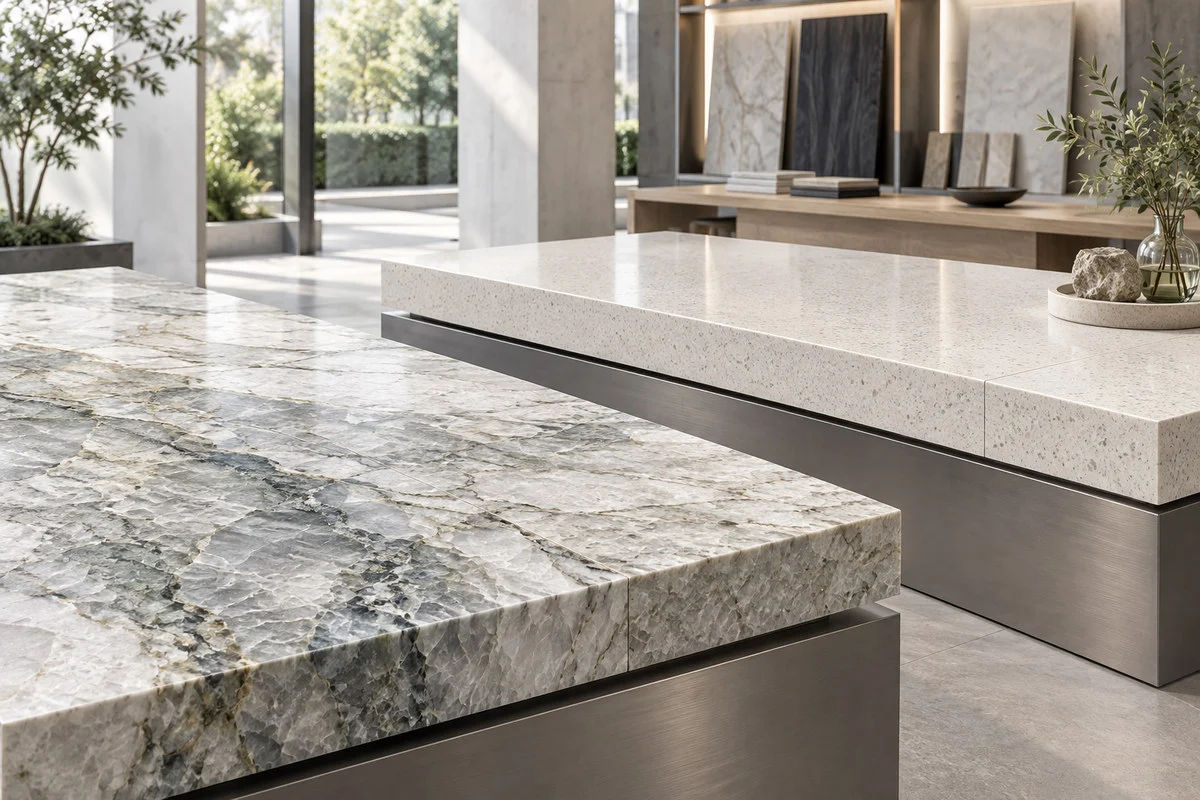
For commercial projects, choose quartzite when authentic slab movement and project-specific stone selection justify greater variation and structured maintenance planning. Choose engineered quartz when repeatable appearance, simpler daily care, and consistent batch matching across hundreds of units carry more weight. Neither material serves as a universal default; the right selection depends on operational demands.
A sound quartzite vs. quartz specification evaluates the exact product, intended location, operating exposure, slab or sample signoff, fabrication details, total installed cost, and the designated maintenance party. These project-specific checks matter more than a generic list of pros and cons.
What Is the Difference Between Quartzite and Quartz Countertops?
Quartzite is a natural metamorphic rock that is quarried and sliced directly into stone slabs. Quartz countertops are manufactured surfaces composed of natural quartz mineral aggregates bound with polymer resins, pigments, and performance additives. The exact formulation varies across manufacturers and product collections.
That fundamental difference shapes how each package is selected and approved. A quartzite buyer approves physical slabs or high-resolution bundle scans because background color, veining intensity, micro-fissures, and usable yield differ from block to block. An engineered-quartz buyer approves a named product code, colorway, surface finish, slab format, and master control sample, as the surface is designed for consistent repeatability. Neither approval should rely on trade names alone.
| Decision point | Quartzite | Engineered quartz |
|---|---|---|
| Material type | Natural stone | Manufactured composite surface |
| Appearance control | Approve actual slabs and layout | Approve the named product and current sample |
| Routine care | Depends on the stone, finish, and sealer plan | Usually follows the manufacturer’s cleaning instructions without field sealing |
| Heat policy | Use trivets and confirm the selected stone and finish | Use trivets and follow the manufacturer’s temperature guidance |
| Main commercial risk | Unapproved variation or avoidable slab loss | Product substitution, lot mismatch, or use outside published limits |

Which Performance Differences Matter in Commercial Use?
Commercial countertop performance depends on the specific slab or product selected, combined with how the space is operated. Evaluate the actual operating environment first, then verify technical documentation covering the approved material, finish texture, edge profile, substructure support, and wet-area exposure. Marketing labels such as “heatproof” or “stainproof” should never replace formal submittal criteria.
Heat and Sun Exposure
Quartzite is frequently specified for projects seeking authentic stone near warm items. The Natural Stone Institute advises trivets for all natural stone installations, and current Caesarstone care guidelines give the same instruction for engineered quartz. Commercial teams must follow the specific manufacturer’s thermal thresholds rather than assuming rules from one brand apply across all quartz products.
Exterior applications require separate verification. Natural quartzite can only be considered outdoors after confirming the exact stone type, surface texture, regional climate, freeze-thaw exposure, substrate framing, and exterior-grade adhesive systems. Engineered quartz should never be installed outdoors unless the manufacturer’s technical data sheets and commercial warranty explicitly approve exterior UV exposure. Neither long-term colorfastness nor weatherability can be inferred from an indoor product sample.

Stains, Cleaning, and Sealing
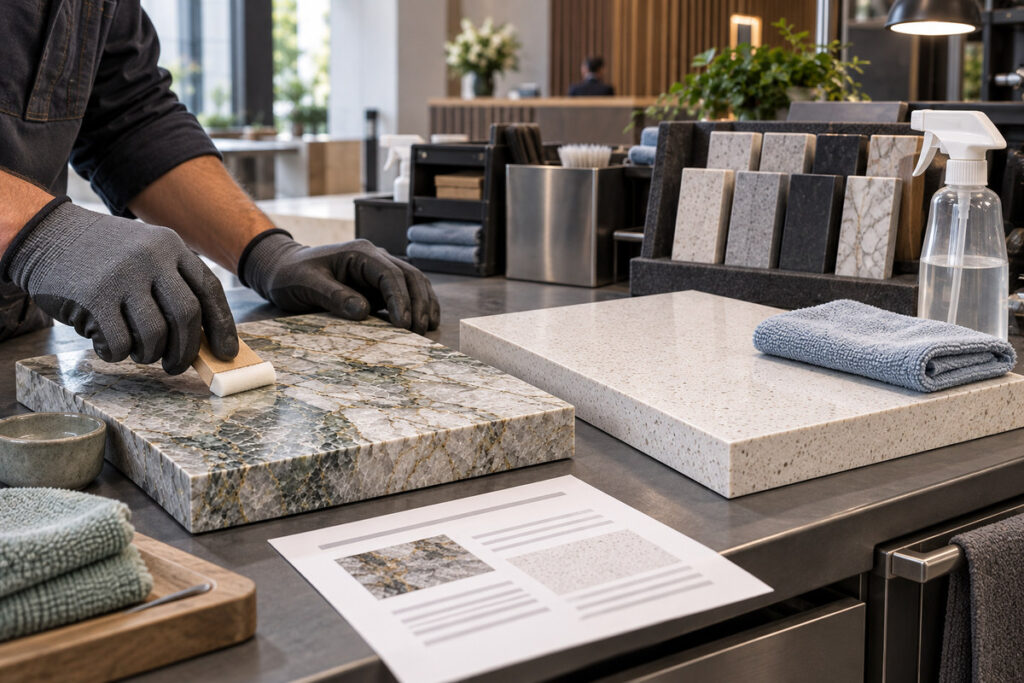
Engineered quartz is widely selected for simpler day-to-day upkeep because quality commercial lines are nonporous and eliminate the need for field sealing. However, cleaning chemicals still demand clear boundaries. Manufacturer maintenance manuals routinely prohibit strong acids, alkalis, industrial solvents, abrasive scouring pads, and prolonged chemical contact, meaning facility teams must receive the approved care sheet prior to occupancy.
Quartzite care varies based on the specific quarry source, porosity, and surface treatment. As the Natural Stone Institute notes, an impregnating sealer functions as a chemical repellent to improve stain resistance; it does not render natural stone stainproof. While exceptionally dense quartzites require no sealing at all, more porous varieties demand initial treatment and scheduled resealing. Have the stone supplier or fabricator test sample cutoffs from the selected bundle, confirm compatible sealers, and document initial application methods alongside renewal cycles before project handover.
Scratches, Chips, and Repair Planning
Both surfaces remain susceptible to mechanical damage along exposed edges, sink cutouts, field seams, and unsupported cantilevers. Project teams should enforce cutting board usage, reinforce vulnerable mitered corners, and prevent point impacts near openings. A Mohs hardness rating alone cannot guarantee that a fabricated edge will resist impact chipping during crating, site transit, installation, or high-traffic commercial use.
Repair protocols should be established before placing production orders. Identify qualified local repair specialists, determine whether color-matched resin fills satisfy visual expectations, and establish attic stock reserves. Natural variation makes sourcing a matching quartzite slab years later nearly impossible. Engineered quartz is easier to identify by product code, but dye lot shifts and discontinued colors can still prevent a clean match.
How Do Appearance and Batch Control Differ?
Managing visual consistency is often the most critical day-to-day distinction between natural quartzite and engineered quartz. Commercial project teams must approve materials using the exact documentation that governs factory fabrication, directly linking each approval to room matrices and shop drawing revisions.
Natural Slab Variation in Quartzite
Quartzite delivers natural depth, dynamic veining, and organic variation that engineered alternatives cannot fully replicate. That individuality also introduces coordination requirements. Project teams must review full-slab photographs or inspect physical slabs, mark usable dimensions, plan how veining flows across seams, and approve cut layouts around major cutouts and waterfall edges.
Nomenclature requires careful verification. If a vendor refers to a stone by a broad trade name, a marble label, or the misleading phrase “soft quartzite,” insist on mineralogical classification and acid-sensitivity testing rather than assuming true quartzite performance. Consulting our guide on marble types helps teams identify why commercial sales names often disguise softer, calcite-based stones.
Repeatable Design in Engineered Quartz
Engineered quartz gives developers and interior designers tight control over color consistency across hundreds of standardized counters. However, submittal documentation must still state the manufacturer, product line, color code, surface finish, slab dimensions, calibrated thickness, and production run or lot reference.
Always examine full-size slabs or large-format architectural samples for directional patterning and joint seams. A compact chip sample cannot represent how broad aggregate patterns or veining will appear across a continuous reception desk or an expansive hospitality buffet.
How Should Quartzite vs. Quartz Cost Be Compared?
Evaluate total approved and installed package costs rather than baseline material prices per square foot. Raw slab pricing represents only one line item in a commercial scope. Published retail pricing rarely reflects overseas project realities involving standardized mass production, custom CNC machining, seaworthy crating, international ocean freight, customs clearance, site logistics, and phased deliveries.
Scope Elements in Commercial Quotations
To achieve true bid parity, commercial tenders must evaluate quotations against an identical scope of work across three critical cost tiers:
| Cost tier | Essential scope items | Commercial consideration |
|---|---|---|
| Material & yield | Gross slab volume, net usable yield, waste factor, and bookmatching premiums | Natural fissures in quartzite reduce yield; quartz provides predictable slab utilization across repeated layouts |
| Detailing & CNC | Shop drawings, edge profiles, undermount cutouts, splashbacks, and steel reinforcement | Complex miters and equipment cutouts increase machining time equally on both hard materials |
| Logistics & site release | Seaworthy crating, ocean freight, customs clearance, site handling, attic stock, and initial sealing | Heavy stone crates require planned offloading equipment, elevator access checks, and on-site surface protection |
Commercial Pricing Drivers for Each Material
Quartzite pricing is primarily governed by block rarity, quarry yield, and the layout labor required to align natural movement across seams. Slabs with dramatic translucent crystal fields or rare coloration command substantial premiums, and natural stone fissures require higher waste allowances during cutting.
Engineered quartz pricing is driven by brand tier, resin-aggregate formulation, surface finish, slab format (standard vs. jumbo), and total production volume. While quartz raw material pricing is more predictable, custom aggregate runs or small batches carry setup surcharges. Conducting a direct-sourcing comparison produces actionable financial clarity only when all bidders price against identical drawing revisions and clear exclusions.
What Should Be Approved Before Ordering Countertops?
Release a commercial countertop production order only after material identity, shop drawings, fabrication limits, MEP interfaces, care sheets, and contractual responsibilities fully align. A signed physical sample without matching drawing revisions or formal product codes does not control what will ultimately be cut, crated, and shipped.
Confirm the Exact Material and Product
For quartzite packages, maintain records of the supplier’s quarry name, slab bundle identifiers, surface finish, calibrated thickness, high-resolution slab scans, total quantities, and relevant absorption or porosity test data.
For engineered quartz, document the manufacturer, collection, product code, finish texture, slab dimensions, thickness, lot reference, current technical data sheets, maintenance instructions, and commercial warranty conditions.
Any proposed substitution must be approved in writing. Quartzite, quartz, marble, and composite surfaces should never share approval references merely because their surface aesthetics look similar.
Lock the Slab Layout and Fabrication Details
Issue dimensioned architectural shop drawings showing exact piece dimensions, field seams, edge profiles, cutout locations, backsplash returns, cantilever overhangs, structural support brackets, finished exposed faces, and vein direction. Cross-reference every fabricated piece to its designated room and floor level. When sourcing materials internationally, maintain drawing revisions, approval signoffs, factory quality control checkpoints, crate labeling, and site receiving plans within a unified submittal log. Utilizing a structured hotel building-material sourcing workflow helps maintain strict quality and schedule control across repeated guestrooms and public areas.
Fabrication and modification work also requires strict health and safety compliance. OSHA and NIOSH identify respirable crystalline silica as a serious occupational hazard generated whenever natural or manufactured stone is cut, routed, drilled, or polished. Factory fabrication and any on-site adjustments must be performed by qualified contractors using wet-cutting methods, local exhaust ventilation, and approved worker respiratory protection programs. Local trade contractors retain direct responsibility for on-site safety and regulatory compliance.

Set Installation, Care, and Handover Requirements
Confirm site dimensions, substrate leveling, substructure framing, access pathways, hoisting logistics, adhesive compatibility, joint caulking, and fixture interfaces with the local site team. Fabricators and installers must highlight any substrate deflection or dimensional variation that falls outside approved specifications before fabrication commences.
Handover documentation should compile approved material specifications, piece-to-room matrices, manufacturer cleaning protocols, sealer maintenance schedules, chemical restrictions, certified repair contacts, attic stock logs, and warranty certificates. Archiving these records alongside the architectural countertop schedule ensures building engineering teams can immediately trace and properly maintain damaged surfaces rather than guessing based on visual appearance.
Which Material Is Better for a Commercial Project?
Engineered quartz serves as the standard choice when a project prioritizes repeatable aesthetics across large guestroom counts, low-maintenance daily care, and standardized manufacturer specifications. Quartzite is the premier option when public spaces or hospitality feature counters demand the unique visual depth of authentic stone, provided the project budget accommodates slab-by-slab layout reviews and disciplined maintenance planning. Commercial projects frequently specify both materials across different interior zones.
| Project condition | Better starting point | Approval condition |
|---|---|---|
| Repeated guestroom vanities or standardized worktops | Engineered quartz | Confirm the named product, current sample, lot control, and care limits |
| Feature counter where natural movement drives the design | Quartzite | Approve the actual slabs, layout, seams, and usable yield |
| Outdoor or high-sun location | Product-specific review | Do not approve either option without written exposure and warranty coverage |
| Frequent hot-item exposure | Operating and product review | Provide heat protection and follow the selected product guidance |
| Difficult future replacement | Either, with spare planning | Retain labeled material or an approved replacement rule |
How Can OKBuild Support a Stone Countertop Package?
OKBuild’s stone and surface-material provides a project entry point for commercial countertops, slabs, samples, lot management, and quotation inputs. Depending on the confirmed project scope, OKBuild can review architectural drawings, takeoffs, surface finishes, client references, physical sample or slab approvals, export crating, and logistics milestones. Stone remains a fabricated or coordinated category unless product-specific documentation establishes a different manufacturing scope.
Clients refining adjacent interior packages can reference the project product categories to separate countertop specifications from custom cabinetry, sanitary fixtures, flooring, lighting, and other commercial scopes before submitting formal RFQs.
For a bounded project review, send OKBuild the issued architectural drawings, bill of quantities, countertop schedule, area list, material specifications, project destination, approval matrix, and required site delivery phases. OKBuild’s platform coordinates procurement and export workflows, while final architectural design, structural engineering, on-site measurement, fabrication safety, local installation, building code compliance, customs duties, and authority approvals remain with the designated local project parties.
Frequently Asked Questions
Can Quartzite and Quartz Be Used in the Same Project?
Yes. Commercial projects regularly install quartzite for signature lobby desks or executive counters while using engineered quartz for high-volume guestroom vanities and back-of-house worktops. Maintaining separate material codes, shop drawings, cleaning instructions, attic stock, and room matrices ensures similar-looking surfaces are never mixed up during fabrication, site installation, or ongoing facility operations.
How Much Spare Countertop Material Should a Project Keep?
Commercial projects have no single attic stock percentage. Quantity determinations depend on total piece repetition, breakage risk during installation, on-site storage conditions, quarry or batch variability, future collection availability, and the complexity of matching installed work. Document all approved spare slabs, fabricated tops, and cutoffs by material code and secure storage location.
Should a Countertop Sample Be Approved Before Shop Drawings?
A physical sample establishes color and finish direction during initial design stages, but final production release requires linking the approved material directly to current, dimensioned shop drawings. Quartzite also requires visual approval of the actual slabs and cutting layouts. If a sample code, slab bundle, surface finish, thickness, edge profile, or cutout dimension changes, update the affected shop drawings and approval logs before fabrication begins.
Who Should Approve a Quartzite Slab Layout?
The project approval matrix should clearly identify the interior designer, client procurement lead, and fabricator. The fabricator prepares a feasible cutting layout based on verified slab dimensions and drawing revisions; the designated design authority signs off on visible vein flow, bookmatching, seam locations, and yield boundaries. Local structural and installation verifications proceed under separate approvals.
Can the Countertop Material Change After Shop Drawing Approval?
Yes, but material changes require a formal, controlled revision. Teams must re-evaluate material identity and appearance, piece dimensions and structural supports, edge and joint fabrication, sealing and warranty terms, cost and lead times, and export and local installation requirements. Formally void superseded samples and drawing sets to ensure factory production proceeds strictly from the latest signed submittal.