

Cabinet core materials and surface finishes](https://okbuilds.com/wp-content/uploads/2026/07/cabinet-material-types-cover.webp)
Cabinet material choice starts with the panel core and surface finish. According to the U.S. Environmental Protection Agency, TSCA Title VI sets formaldehyde emission limits for hardwood plywood made with veneer or composite cores, MDF including thin MDF, and particleboard. Covered importers, fabricators, distributors, and retailers must also keep compliance records. Material selection must still account for strength, moisture response, edge quality, cleaning, and repair.
Commercial teams should match each core and finish to the component, load, hardware, exposure, and cleaning plan. This guide compares the main types of cabinet materials, including plywood, MDF, particleboard, combination cores, HPL, TFL, veneer, paint, thermofoil, and acrylic. It also explains what to approve in samples, BOQs, and shop drawings before production.
What Are the Main Cabinet Core Materials?
Commercial cabinets commonly use four core groups. The table gives a starting point, but the specified grade and completed assembly control final performance.
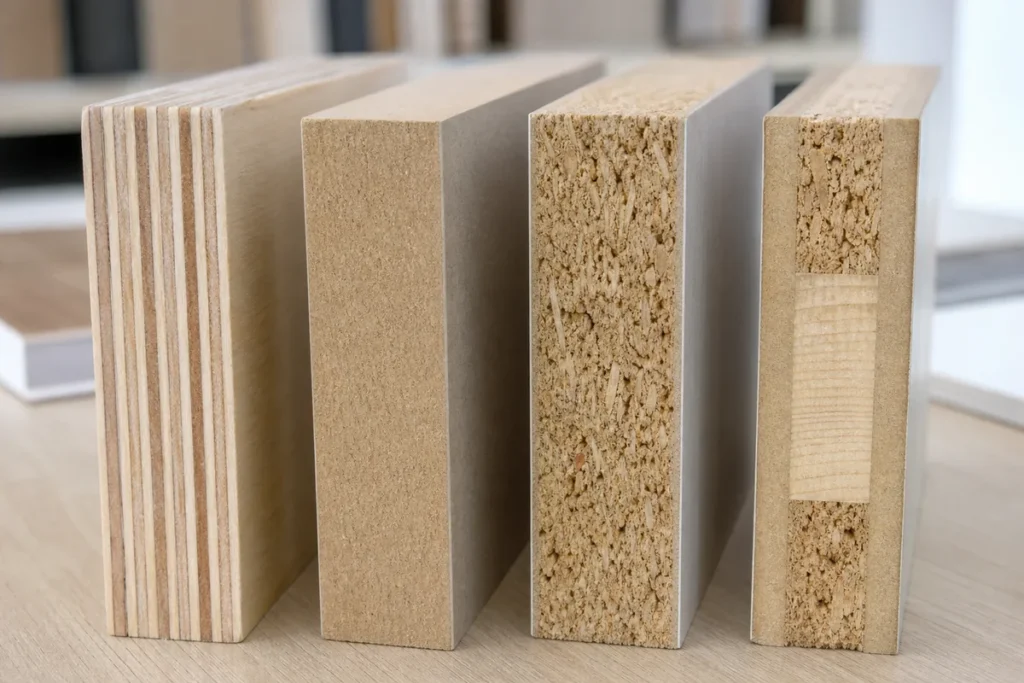
| Core material | Common component fit | Main reason to consider it | Main watchpoints |
|---|---|---|---|
| Plywood | Boxes, shelves, and connection-heavy parts | Good panel strength and fastener holding in a suitable grade | Internal voids, ply quality, exposed edges, and adhesive rating |
| MDF | Painted or routed fronts and decorative panels | Smooth face and consistent machining | Weight, edge fasteners, and swelling at unsealed cuts |
| Particleboard | TFL or HPL boxes, interiors, shelves, and fronts | Flat surface for decorative laminates | Grade-specific fastener holding and water at exposed edges |
| Combination core | Panels needing a specific face or mixed construction | Can combine surface quality with selected core properties | The name does not define the layers, bonds, or edge construction |
Plywood Cores
Plywood consists of bonded veneer plies whose grain usually alternates between layers. Performance varies with species, ply count, voids, adhesive, grade, and fastener location. Specify the standard, grade, thickness, face material, exposure class, and edge treatment. Approve visible edges with a sample that shows the ply pattern and void filling.
Medium-Density Fiberboard (MDF) Cores
Medium-density fiberboard uses wood fibers bonded under heat and pressure. Its uniform face suits paint, lacquer, veneer, laminate, and routed profiles. Check density and finished door weight when sizing hardware. MDF edges need suitable pilot holes, inserts, and coating preparation. Standard MDF can swell at wet, unsealed cuts. A moisture-resistant grade may reduce swelling under its test conditions, but it is not waterproof by default.
Particleboard Cores
Particleboard uses wood particles bonded with resin and pressed into a panel. Its flat surface works well with thermally fused laminate and high-pressure laminate. Fastener holding depends on grade, density, thickness, fastener type, embedment, and edge distance. Repeated removal can weaken the connection. The material schedule should name the grade and component use rather than treating every particleboard panel as equal.
Combination Cores
Combination core can describe a panel that mixes veneer with MDF or particleboard. It can also describe a cabinet assembly that uses different cores for boxes, fronts, and backs. State the exact meaning. Record each layer, total thickness, face and back materials, bonding method, edge construction, intended component, and supporting test data.
What Surface Finishes Are Used on Commercial Cabinets?
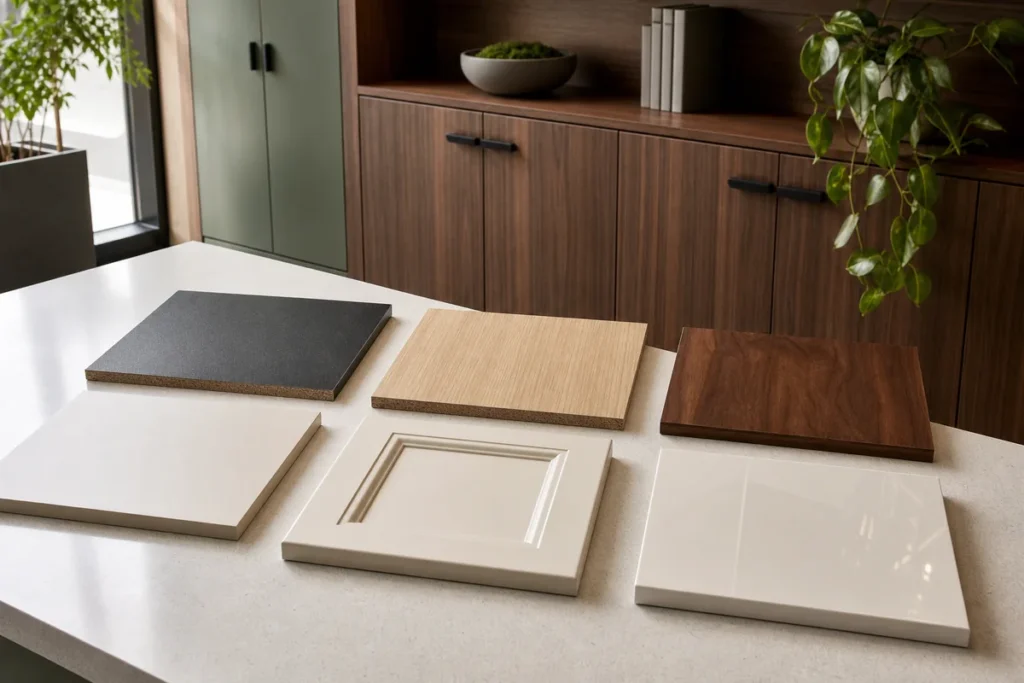
Commercial cabinet finishes include HPL, TFL, wood veneer, clear coatings, paint, lacquer, thermofoil, and acrylic. Choose by wear, cleaning method, heat and moisture exposure, color tolerance, edge shape, and repair plan. When cabinetry coordinates with other commercial project product categories, use shared finish codes for counters, furniture, flooring, and wall surfaces.
HPL and TFL Laminate Surfaces
Manufacturers produce high-pressure laminate, or HPL, as a separate sheet that fabricators bond to a substrate. Thermally fused laminate, or TFL, uses resin-treated paper fused directly to MDF or particleboard. HPL comes in grades for different horizontal and vertical uses. TFL arrives as a finished panel. Compare the grade, substrate, test results, service condition, texture, gloss, balancing material, seams, and edge band.
Wood Veneer and Clear-Coated Surfaces
Wood veneer places a real wood face over a panel core. Species, veneer cut, leaf match, panel sequence, stain, topcoat, and grain direction shape the finished elevation. Approve a sample that shows the expected range. State whether veneer sequence continues across adjacent fronts. Shallow damage may accept a local repair, while a deep cut can require a matched panel.
Painted and Lacquered Surfaces
Paint and lacquer form an opaque finish over a prepared substrate. MDF often suits routed fronts because its face is smooth and has no visible grain. Specify the color reference, gloss range, coating system, face classifications, edge preparation, and touch-up method. High gloss makes waves, dust, scratches, and repairs more visible, so approve a finished component when appearance is sensitive.
Thermofoil and Acrylic Surfaces
Thermofoil uses a heat-formed film bonded over a shaped substrate. Heat, steam, tight radii, exposed edges, adhesive choice, and forming quality can affect the bond. Acrylic uses a layer bonded to a panel or supplied as a finished panel. Its construction affects scratches, flatness, edge matching, and cleaning. Approve the core, surface layer, adhesive, edge detail, and corner sample for either system.
How Do Cabinet Material Types Affect Performance?
Cabinet performance comes from the full assembly. Core grade, thickness, joints, surface, edges, hardware, fabrication, installation, and exposure work together.
Strength and Fastener Holding
Evaluate strength at the actual joint. Shelf span, door weight, drawer load, fastener diameter, embedment, edge distance, and service frequency all affect the connection. For heavy shelves, large fronts, pull-out hardware, or wall-mounted units, request hardware limits, calculations, test data, or a mockup as needed. Panel data does not replace wall blocking, anchors, or structural design by the responsible local professional.
Dimensional Stability and Moisture Response
Wood-based panels respond to moisture in different ways. Unequal exposure between faces can cause bowing. Water at unsealed edges, sink cutouts, joints, or damaged finishes can cause swelling, staining, or bond failure. Use balanced construction when required, seal exposed cuts, control leaks, and follow storage instructions. Damp locations need product-specific data. Do not specify standard interior panels as exterior or waterproof construction.
Surface Wear and Cleaning Resistance
The finish receives daily abrasion, stains, cleaners, heat, and impact. Product grade, color, gloss, and texture affect measured performance and the visibility of marks. State the required resistance and test method when wear affects approval. Check the facility’s cleaning chemicals, concentration, contact time, and frequency against product instructions. “Commercial grade” is not a measurable requirement.
Repairability and Replacement
Paint may accept a local repair, although color or gloss differences can remain visible. Clear-coated veneer may allow touch-up until damage passes through the veneer. Visible damage to laminate, thermofoil, or acrylic often calls for component replacement. Removable fronts and end panels make that work easier. Retain finish formulas, sample codes, veneer records, hardware schedules, and batch details, but do not assume a later batch will match exactly.
How Should Materials Be Matched to Cabinet Components?
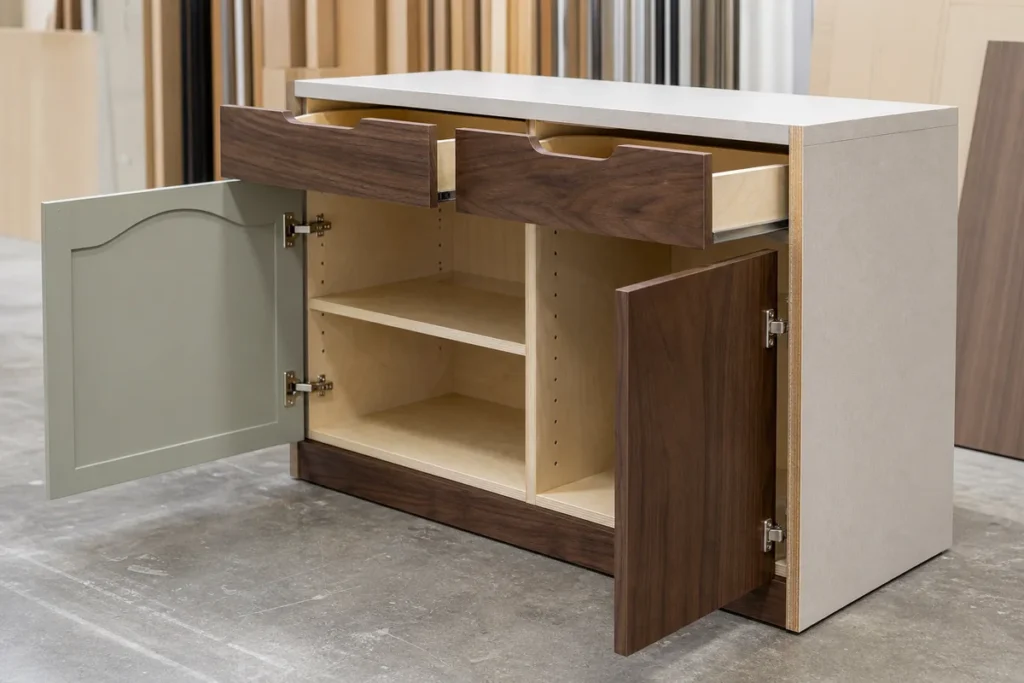
The best material for kitchen cabinets or other commercial casework depends on the component, load, size, hardware, finish, and exposure. One cabinet may use different core and surface combinations. If cabinetry belongs to a wider commercial fit-out materials package, coordinate its interfaces with counters, wall finishes, services, and adjacent trades.
Cabinet Boxes and Shelves
In custom cabinetry and millwork, cabinet boxes need stable panels, reliable joints, finished visible edges, and hardware connections suited to the service load. Shelf thickness must also control deflection across the clear span. Record the core grade, thickness, back construction, shelf supports, faces, and edge band. In sink cabinets and other wet-use areas, show how cutouts, seams, penetrations, and exposed edges will be sealed.
Doors and Drawer Fronts
Compare cabinet door material types as finished assemblies. Flatness, size, weight, hinge holding, edge appearance, and finish consistency matter more than the core name alone. Shop drawings should show grain or pattern direction, matching across adjacent fronts, pull and hinge locations, edge profile, back finish, and maximum size. Check hardware limits against the completed front, including its surfaces, pulls, and accessories.
Drawer Boxes and Back Panels
Drawer boxes must suit the selected slides, joints, bottom panel, load, and use frequency. Specify each part, edge finish, joint, and slide attachment. Cabinet backs can square the case, close the interior, or form part of a hanging system. Thin, captured, applied, and structural backs do different jobs. Drawings must separate cabinet-back requirements from wall blocking and building anchors.
Exposed End Panels and Finished Edges
Visible ends and edges need the same appearance control as doors. Define whether an end panel is integral or removable. Show returns, fillers, scribes, toe kicks, open shelves, and counter interfaces. State the edge material, thickness, profile, color, gloss, corner treatment, adhesive when relevant, and permitted joints. Face approval does not approve an exposed core line, open seam, or unmatched edge band.
How Should Project Teams Specify and Approve Cabinet Materials?
Use one controlled record that links every component to its core, surface, edge, performance requirements, sample, and drawing revision. A visual sample does not replace technical approval. If cabinets form part of a hotel FF&E schedule, use the same item and finish codes in both records.
Cabinet material sample and drawing review](https://okbuilds.com/wp-content/uploads/2026/07/cabinet-material-sample-approval-1024x683.webp)
Defining Core, Surface Finish, Thickness, and Edge Requirements
Build the schedule by component. For each box side, shelf, back, door, drawer front, drawer box, end panel, filler, and toe kick, state:
- Core type, grade, and finished thickness
- Face and back surfaces
- Edge material and profile
- Color, pattern, gloss, or texture
- Approved location and exposure
- Hardware connection requirements
Avoid shorthand such as “laminate cabinet” or “MDF door.” If the specification permits equivalents, state the minimum properties and proof required before quotation.
Identifying Performance and Compliance Requirements
Set requirements from the project location, adopted code, room use, owner standard, cleaning plan, and contract. Identify any load, wear, impact, stain, chemical, moisture, fire, or emissions criteria. Name the test method or regulatory basis when one applies.
For U.S. projects, determine which panels, laminated products, components, or finished goods fall within EPA TSCA Title VI. Testing, labeling, and recordkeeping duties vary by product and supply-chain role. Fire documents must cover the exact material or assembly required by the code and specification.
Reviewing Material Samples and Technical Data
Pair the sample with current technical data. Show the core, both faces, edge, corner, seam, profile, color, texture, and gloss. The data should identify the manufacturer, product code, grade, thickness, test results, limits, cleaning instructions, and compliance status. A face sample cannot prove the internal core, so request a labeled cross-section or panel document when the core affects approval. Use a larger sample for veneer range, high gloss, pattern matching, curved edges, or hardware interfaces.
Recording Approved Materials in BOQs and Shop Drawings
The bill of quantities, material schedule, sample register, and shop drawings should share item codes and revision status. Each cabinet item should connect its location and quantity to the approved materials, hardware, dimensions, and performance records. Resolve conflicts before production, record substitutions in writing, and issue coordinated revisions. For an OKBuild cabinetry package, we use the same approved item reference across purchasing, fabrication, inspection, packing, and replacement records, as described in our hotel material sourcing from China workflow.
Frequently Asked Questions
How Is Solid Wood Used Differently From Panel Cores?
Solid wood commonly forms rails, stiles, frames, edging, moldings, trim, and selected door or drawer parts. It moves across the grain as moisture changes. Panel cores can provide a flatter broad face, while solid wood can support profiled edges and traditional joinery.
Are Moisture-Resistant and Waterproof Core Panels the Same?
No. A moisture-resistant panel limits specified moisture effects under defined test conditions. The rating does not prove resistance to flooding, standing water, exterior exposure, or water entering unsealed cuts. Accept a waterproof claim only when test data covers the proposed product, edges, joints, exposure time, and completed assembly.
Should Exposed, Semi-Exposed, and Concealed Surfaces Use the Same Finish?
Not necessarily. Exposed surfaces need the tightest visual control. Semi-exposed and concealed faces may use a compatible finish with different appearance requirements. Name each surface in the schedule. Some panels need a balancing material on the concealed face for flatness. Open doors, glass fronts, and reflected views can also expose that face.
When Do Commercial Cabinet Materials Need Fire or Emissions Documentation?
Documentation is required when the destination law, adopted code, contract, owner standard, or authority having jurisdiction calls for it. For U.S. projects, regulated composite wood panels and certain finished goods may fall under EPA TSCA Title VI. A fire submittal should identify the tested construction, classification, thickness, substrate, adhesive, and installation condition.
How Should Proposed Material Substitutions Be Reviewed?
Compare the proposed assembly with the approved one. Check core grade, thickness, surface, edge system, flatness, fastener performance, moisture limits, test data, compliance documents, cleaning, lead time, and hardware impact. Record the decision and revision before production. Update the BOQ and shop drawings when cabinet construction changes.