

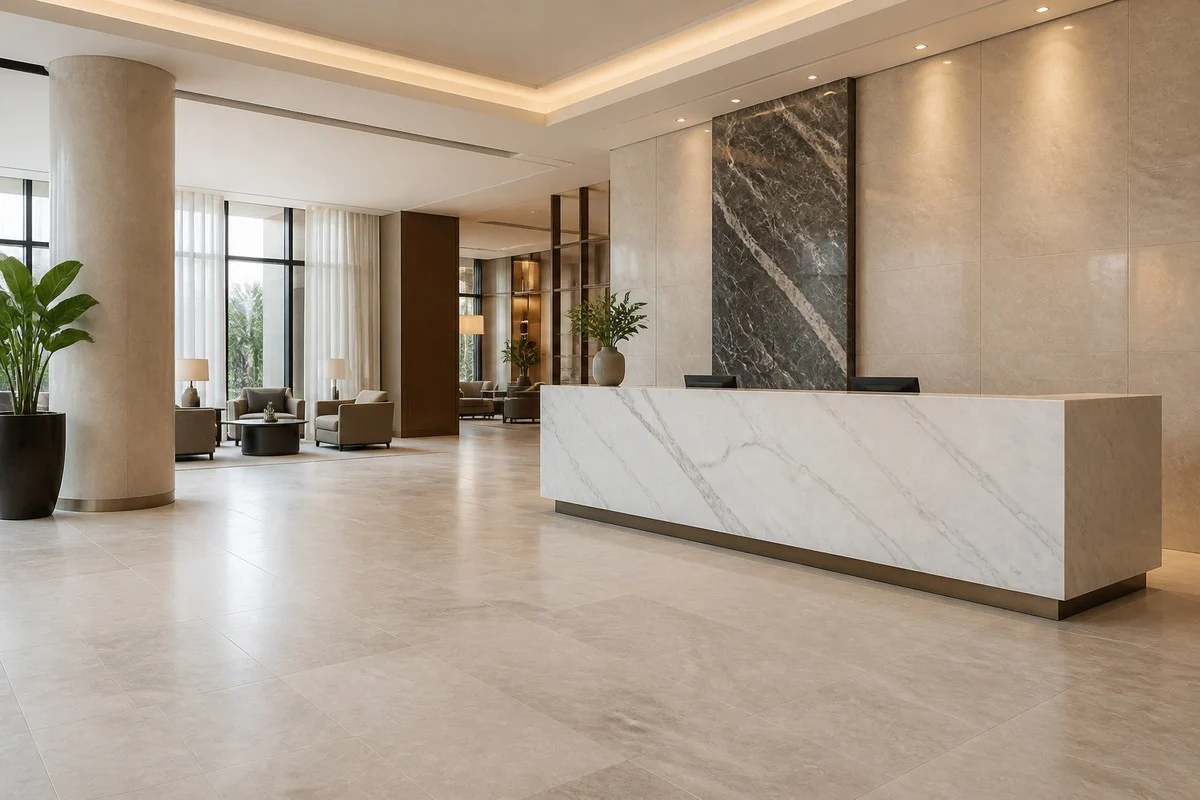
Marble is one of the few materials that spans nearly every category of commercial interior: lobby floors, bathroom vanities, feature walls, reception counters, and corridor cladding. For procurement teams and project managers, the challenge is not finding marble but selecting the right type, finish, and grade for each application.
This guide covers the commercially relevant types of marble, the finish and grading decisions that affect specification, and the procurement steps that determine whether stone arrives consistently across a large project.
What Makes Marble Different from Other Commercial Stone?
Marble is a metamorphic rock formed when limestone recrystallizes under heat and pressure. That process creates its characteristic veining and produces a material denser than limestone but softer and more reactive than granite.
In commercial contexts, two properties drive most specification decisions:
- Calcium-based reactivity. Marble reacts chemically with acidic substances such as cleaning fluids and food spills, causing surface etching that no sealant prevents.
- Batch variability. The same geological variety can differ substantially between quarry blocks and production batches, making controlled procurement essential for large-scale installations.
The stone and surfaces category covers the range of natural stone, engineered stone, and fabricated surface applications relevant to commercial fit-out projects.
Which Types of Marble Are Used Most in Commercial Interiors?
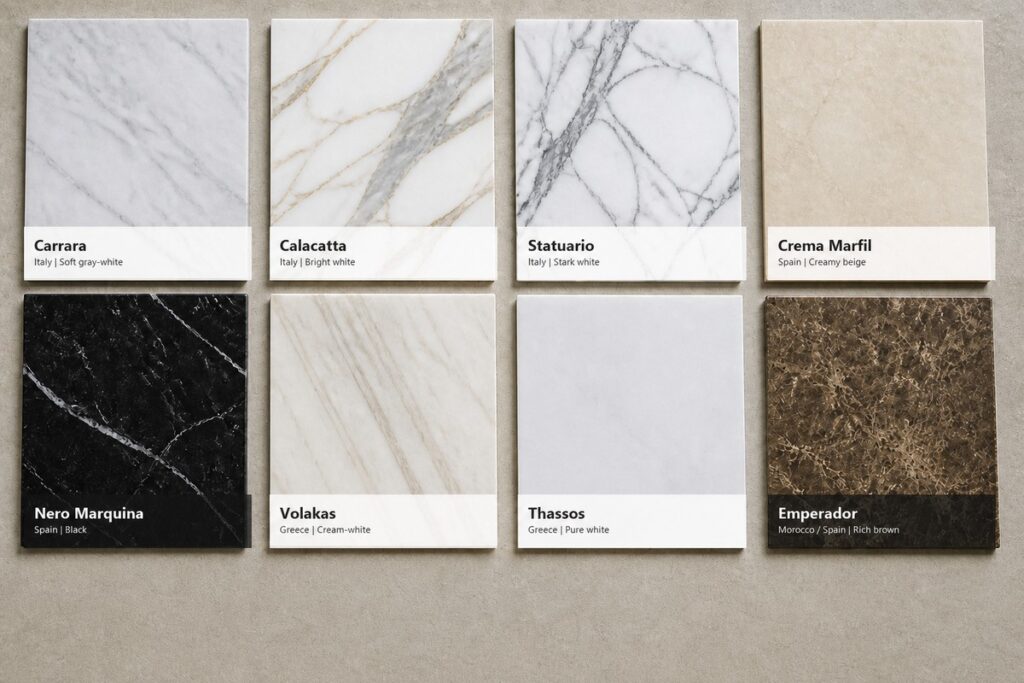
The most commercially specified marbles come from quarrying regions in Italy, Spain, and Greece. The table below provides a quick reference across eight varieties; the sections that follow explain the commercial selection criteria for each. For hotel projects that combine stone with FF&E and soft furnishings, the hotel FF&E procurement guide covers how stone scope integrates with furniture and fixture packages in a coordinated delivery plan.
| Type | Origin | Background | Veining | Common Application |
|---|---|---|---|---|
| Carrara | Italy | Soft gray-white | Fine, feathery gray | Large-scale flooring, vanities, guestroom bathrooms |
| Calacatta | Italy | Bright white | Bold; gold and gray tones | Statement lobbies, reception desks, feature walls |
| Statuario | Italy | Stark white | Crisp, dark gray | Luxury executive areas, grand lobbies |
| Crema Marfil | Spain | Warm creamy beige | Subtle, consistent | Corridors, spa areas, warm-tone public spaces |
| Nero Marquina | Spain | Black | Sharp white veins | Accent features, bar fronts, high-contrast elements |
| Volakas | Greece | Cream-white | Distinct linear | Contemporary luxury hotel interiors |
| Thassos | Greece | Pure white, crystalline | Minimal | High-reflectivity spaces, contemporary design |
| Emperador | Morocco/Spain | Rich brown | Fine, dense | Warm-tone areas where wear concealment is a priority |
Carrara
Carrara marble has a soft gray-white background with fine, feathery gray veining that tends to be consistent across slabs within the same quarry block. It is the most widely available and most affordable of the Italian white marbles, making it a practical choice for full bathroom surrounds in hotel guestrooms, vanity tops, corridor flooring, and lobby surfaces where a classic, understated finish is the brief. Because it is relatively porous, Carrara requires a sealing schedule and performs better in honed finishes on high-traffic floors than in polished ones that will show surface scratches over time.
Calacatta
Calacatta marble is quarried from the same Apuan Alps region as Carrara but is significantly rarer and more expensive. Its bright, clean white background provides high contrast for bold, dramatic veining that often includes gold, deep gray, and beige tones in large, sweeping patterns. In commercial interiors, Calacatta is typically reserved for statement applications: reception desks, boardroom surfaces, feature walls in luxury lobbies, and premium hotel suite bathrooms. It reads better as a focal-point material than as a broad floor field, where the cost and visual impact are both difficult to justify.
Statuario
Statuario is the rarest and most expensive of the three principal Italian white marbles. Its near-snow-white background and distinct, crisp dark-gray veining create strong visual contrast without the gold or beige warmth found in Calacatta. Consistent large-format supply is harder to secure, and individual slabs can command a significant price premium. Statuario is typically specified for executive areas, high-end spa reception zones, or architectural feature elements where the brief demands museum-quality exclusivity. For most commercial specifications requiring a premium white marble, Calacatta is the more available alternative.
Crema Marfil
Crema Marfil is a warm creamy-beige marble from Spain with subtle, consistent veining that makes it one of the most forgiving stones for large commercial installations. Its neutral warmth works well in corridors, spa waiting areas, and public spaces where a calm, inviting tone is the design intent. Because the veining is understated, slight color variation between batches is less visually disruptive than with more dramatically patterned varieties. It is also a cost-effective alternative to Italian whites in projects where budget and availability are constraints.
Nero Marquina
Nero Marquina is a black marble from Spain with sharp, contrasting white veins that make it one of the most visually distinctive materials in commercial interiors. It is rarely used as a primary floor material across large areas. Instead, it performs best as an accent: bar fronts, feature columns, reception counter panels, lift lobby walls, and inlay borders within lighter stone floors. Specify it in polished finish for maximum contrast, and plan for joint sealing and maintenance guidance to clients, as light-colored grout can highlight any installation imprecision.
Volakas
Volakas is a Greek marble with a cream-white background and distinct, linear veining that gives it a structured, contemporary quality compared with the more organic patterns of Italian whites. It is widely used in luxury hotel lobbies, corridor flooring, and bathroom cladding in markets across Asia and the Middle East. Its consistent veining makes bookmatching and large-format tile layouts more predictable than with heavily varied stones, and its price point typically falls below Calacatta and Statuario while still reading as a premium material.
Thassos
Thassos is a pure white, crystalline marble quarried exclusively on the Greek island of Thassos. Its background is the brightest white available in natural stone, with minimal veining, which makes it a preferred material for spaces where maximum light reflection and a clean, monolithic appearance are the design goals. It is commonly specified for spa interiors, high-end retail, and contemporary hotel bathrooms where an all-white palette is the brief. Thassos is calcium-based and requires careful attention to sealing and maintenance, particularly in wet areas.
Emperador
Emperador marble comes primarily from Morocco and Spain and is distinguished by its rich brown background with fine, dense veining in cream and lighter brown tones. The dark base color conceals wear and surface variation more effectively than lighter marbles, which makes it a practical choice for high-traffic areas where a warm tone is the design requirement. It is commonly used for feature walls, countertops, and accent flooring in hotel bars, restaurants, and executive lounges. Two grades are widely available: Dark Emperador has a deeper brown background, while Light Emperador trends toward warm beige-brown.
How Do Marble Finishes Affect Commercial Performance?
A marble’s finish affects its maintenance schedule, slip risk, and long-term appearance as much as the stone type itself does. The finish decision belongs in the specification document alongside the stone type and grade.
Polished Finish
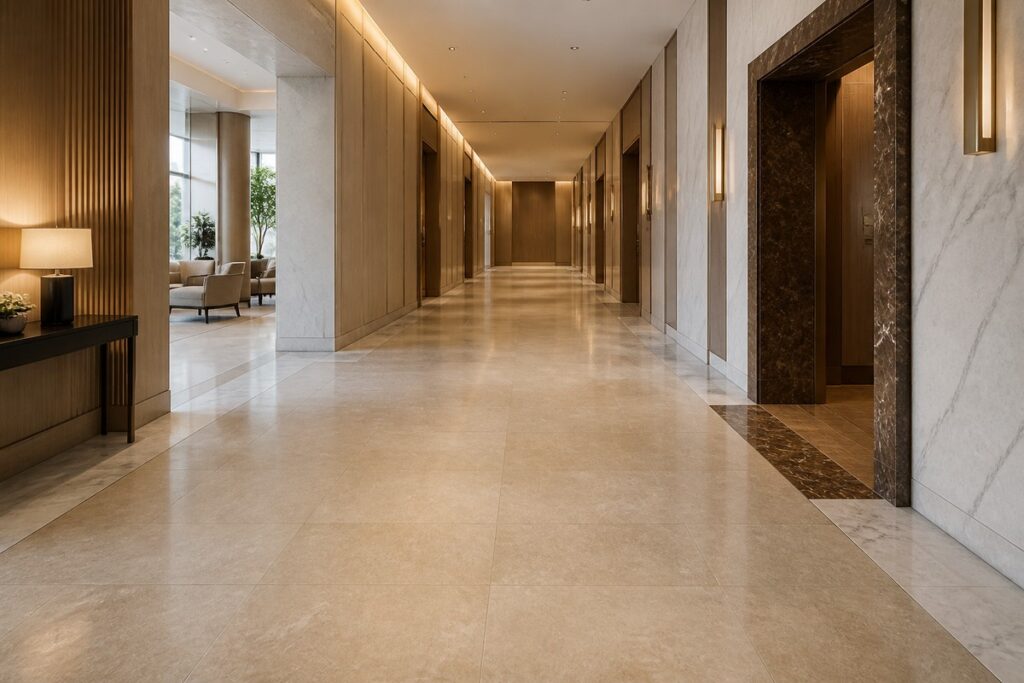
A polished finish produces a high-gloss, reflective surface that intensifies the stone’s color and shows the veining at its most dramatic. It is best suited to wall cladding, feature panels, and decorative applications where foot traffic is low or absent. On commercial flooring, polished surfaces are more slippery when wet and show scratches and wear patterns more readily. Most commercial specifications restrict polished finishes to vertical surfaces and low-contact accent applications.
Honed Finish
A honed finish produces a flat, matte or satin surface. For commercial flooring in lobbies, corridors, and bathrooms, it is generally the preferred specification. It provides better slip resistance than polished surfaces, conceals minor surface etching more effectively, and maintains a more consistent appearance under heavy use.
Brushed and Textured Finishes
Brushed finishes use wire or abrasive tools to create a slightly rough, tactile surface texture. Flamed and bush-hammered finishes produce more pronounced surface relief. These suit niche applications: outdoor paving, spa wet-zone flooring, and specialty feature walls where texture is part of the design intent. Verify that the specific stone grade and thickness are appropriate before specifying them for structural floor applications.
What Does Commercial Marble Grading Mean for Your Specification?
Two separate grading systems apply to commercial marble purchases, and confusing them leads to specification errors. Understanding how these systems work also applies to other commercial materials: the cabinet material types guide explains how core materials and surface finishes are similarly graded and specified for commercial interior casework.
The first is the technical soundness classification established by the Natural Stone Institute and referenced in ASTM C503:
| Group | Condition | Fabrication Requirement |
|---|---|---|
| A | Sound, uniform | Minimal to no repair |
| B | Minor natural faults | Minimal repair acceptable |
| C | Noticeable voids, veins, separation | Standard sticking, waxing, and filling expected |
| D | Maximum variation, extensive faults | Most intensive repair; often highly decorative stones |
This system is technical, not aesthetic. A Group D marble may be visually dramatic and command a high price while requiring significant fabrication work.
The second system is the commercial grade label: Premium, Select, Grade A, Grade B. These labels have no universal definition, and two suppliers may use “Grade A” to mean entirely different things. For commercial specifications, verify the supplier’s specific grading criteria rather than assuming a label implies a standard.
How Do You Match, Batch, and Approve Marble for a Large Project?
Natural stone varies between slabs and between quarry batches. The decisions made at the sourcing and approval stage determine whether a commercial installation looks coherent at handover or shows visible inconsistency across rooms and phases.
Batch and Lot Control
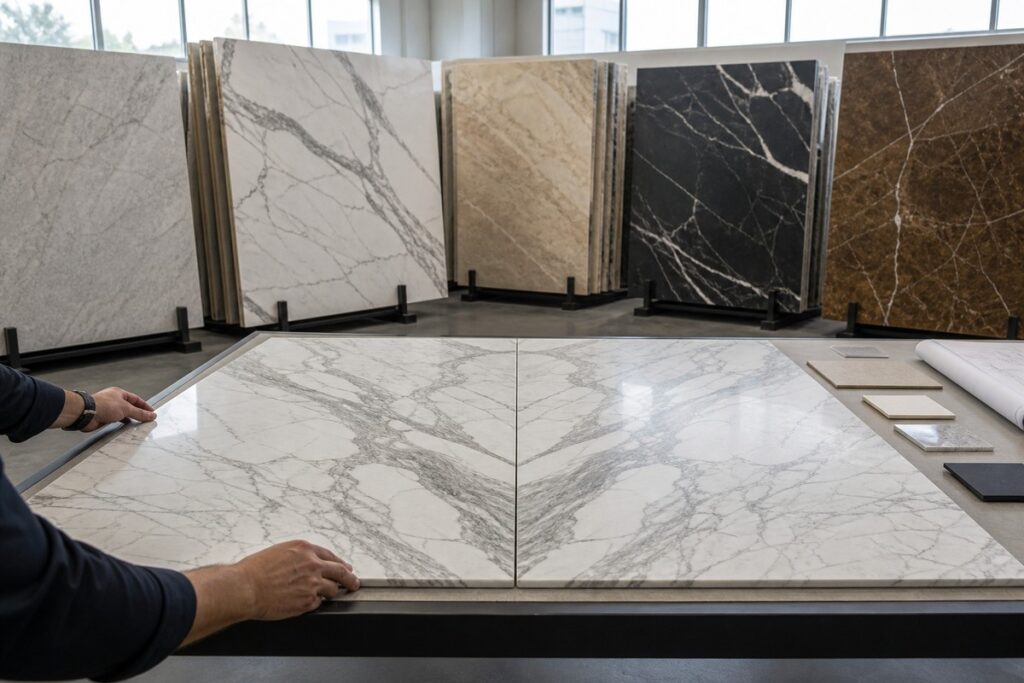
For any commercial project with a significant marble scope, request that the entire quantity be sourced from the same quarry block or production lot. Material from different blocks can differ noticeably in background color, veining density, and finish response, even when all pieces carry the same variety name. The hotel building materials sourcing guide covers how batch coordination and supplier verification fit into a broader hotel procurement plan, including BOQ preparation and QC handover documentation.
Slab Selection and Approval
Small samples do not represent the full range of a marble slab. Before approving stone for a high-impact application, review full-slab photographs or inspect the actual slabs intended for the order. For vein-matched or book-matched installations, a dry-lay layout review of the specific slabs in the proposed sequence is the only reliable method of confirming the final appearance.
Bookmatching and Vein Direction
Bookmatching places two sequentially cut slabs mirror-image side by side, creating a symmetrical vein pattern across a joint. It is commonly specified for feature walls, waterfall countertop edges, and architectural panel installations. The shop drawings must indicate which slabs are to be paired, the orientation and direction of the vein, and the joint treatment. The project team must review and approve the dry-lay sequence before fabrication begins, since reversing a book-matched pair after cutting is not recoverable.
We coordinate stone selection, slab review, and fabrication for commercial interior projects through our project services workflow. Sending the finish schedule and material quantities early in the project allows us to confirm availability and plan the review process before procurement commitments are made.
Tell us about your project to start the scope review and verify lot availability.
Frequently Asked Questions
Is Marble a Practical Choice for Commercial Flooring?
Yes, when the correct type, finish, and maintenance plan are in place. Dense varieties in a honed finish perform well in moderate-to-high-traffic lobbies and corridors. In very high-traffic zones, some specifications reserve natural marble for accent areas and walls and use marble-look porcelain tile for the floor field.
Does Sealing Marble Prevent Etching?
Sealing protects against staining by slowing liquid absorption, but it does not prevent etching. Etching is a chemical reaction that occurs when acidic substances such as citrus juice, wine, or certain cleaning products contact the calcium-based stone surface and dull or pit it. A honed finish reduces the visible impact of etching compared with a polished surface.
How Much Extra Marble Should a Commercial Project Order for Waste?
A standard wastage allowance is 10% to 15% above the net installation area, depending on layout complexity and the proportion of cut pieces. Projects with diagonal layouts or book-matched patterns fall at the higher end of that range. Allow an additional 2% to 5% reserve quantity for post-handover repairs.
Is All Marble the Same Hardness?
No. Marble falls within approximately 3 to 4 on the Mohs hardness scale, softer than granite (6 to 7) and harder than limestone. For applications where abrasion resistance is a primary concern, request the supplier’s ASTM C241 abrasion resistance data for the specific stone and lot.
Can Marble Be Used in Hotel Bathrooms and Wet Areas?
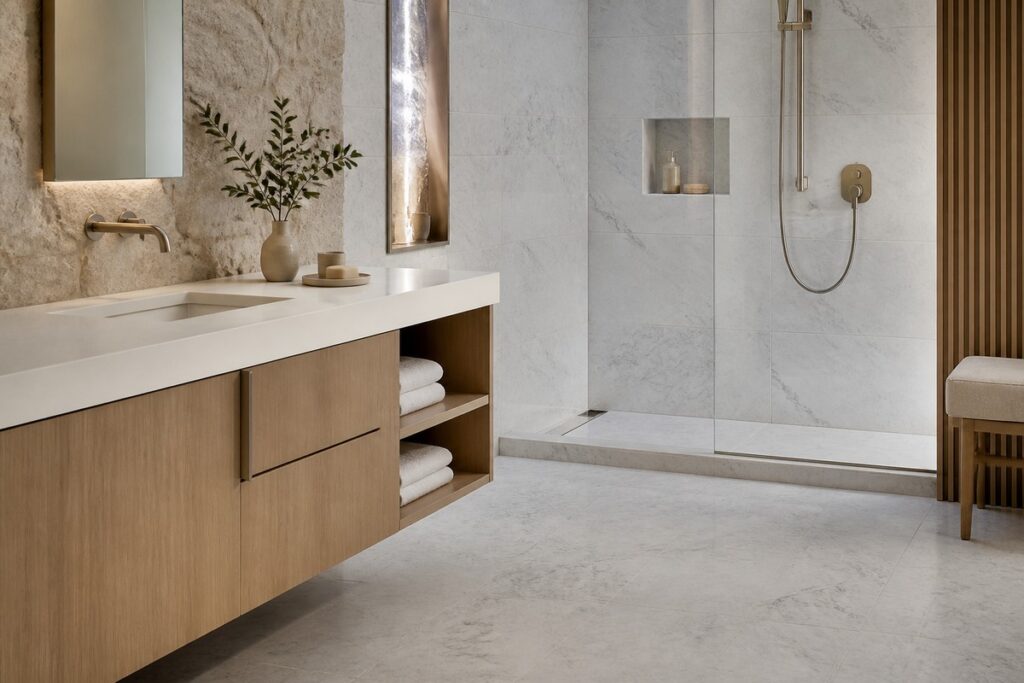
Yes. Marble is widely used for vanity tops, shower walls, bath surrounds, and bathroom floor tiles in hotel projects. Specify a honed finish for wet-zone floors to improve slip resistance, and maintain a regular resealing schedule as part of the hotel’s maintenance plan.