

Lumens measure light output; watts measure electrical input power. To compare LED lighting, check how much light each product produces, how much power it draws, and whether both figures describe the same product configuration. Wattage alone cannot tell you which LED produces more light.
Start with the light output your application needs, then compare the power required to provide it. For a commercial fixture, the useful figures are the lumens leaving the complete fixture and the electrical power needed to run that fixture.
What Do Lumens, Watts, and Lumens per Watt Measure?
Lumens describe output, watts describe power demand, and lumens per watt connect the two.
| Metric | What it measures | What it helps you compare |
|---|---|---|
| Lumens (lm) | Total visible-light output | How much light the product emits |
| Watts (W) | Electrical input power | How much power the product draws while operating |
| Lumens per watt (lm/W) | Light output divided by input power | How effectively the product produces light from electricity |
Luminous efficacy is the technical name for lumens per watt. A higher value means more emitted light per watt of electrical input. The Federal Energy Management Program (FEMP) at the U.S. Department of Energy (DOE) calculates luminaire efficacy as luminous flux divided by luminaire input watts. FEMP also advises comparing efficacy only between like products.
How Can You Compare Two LED Options?
Hold one figure constant and compare the other, or calculate lumens per watt when both differ. The following numbers are hypothetical examples, not OKBuild product specifications or test results.
Same Watts: Compare Light Output
Suppose two complete LED fixtures each draw 20 W. Fixture A emits 2,000 lm; Fixture B emits 2,600 lm. At the same input power, B provides more total light output.
This comparison answers whether one option delivers more light for an available power allowance. It does not establish which fixture will illuminate a particular surface better, because their light distributions may differ.
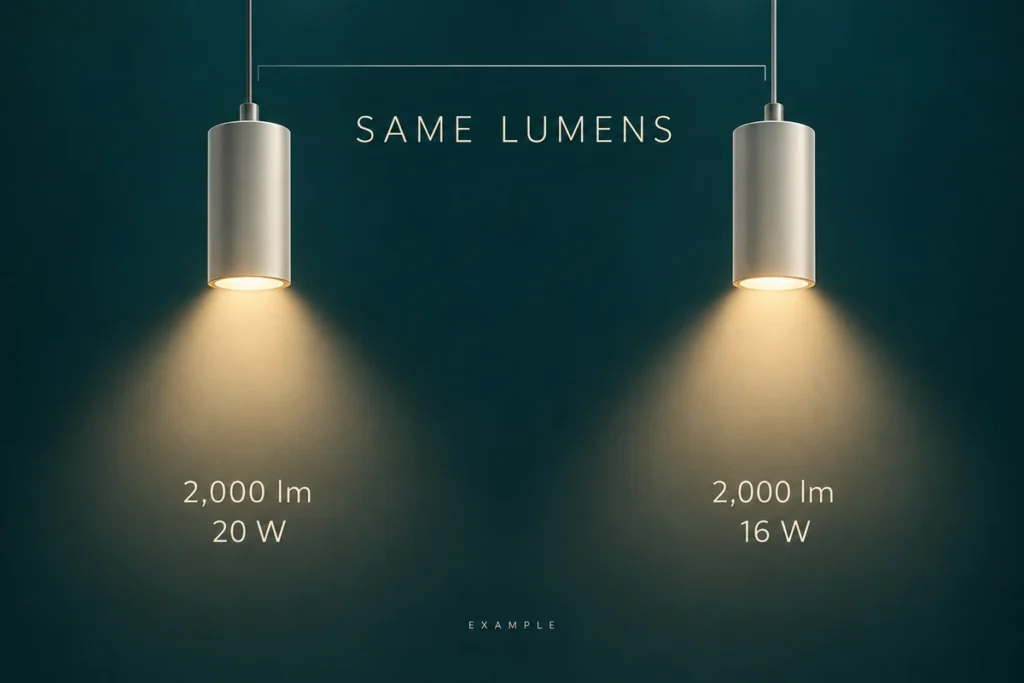
Same Lumens: Compare Input Power
Now suppose two fixtures each emit 2,000 lm. One draws 20 W, and the other draws 16 W. The 16 W fixture needs less power to produce the same total light output.
If both meet the application’s lighting requirements, the lower input power is an advantage. Check the selected color quality, optics, and operating setting before accepting the two products as comparable.
Lumens per Watt: Compare Efficacy
Calculate efficacy when output and wattage both differ:
Luminous efficacy (lm/W) = light output (lm) ÷ input power (W)
Suppose a third fixture emits 3,000 lm at 25 W. Its efficacy is 120 lm/W, compared with 100 lm/W for the 2,000 lm, 20 W fixture. The third fixture produces more light per watt. Still, a higher lm/W rating does not compensate for an unsuitable distribution or missing specification.
How Do You Convert Lumens to Watts?
You can convert lumens to watts only when you know the product’s luminous efficacy. There is no fixed LED wattage for a given lumen output.
Lumens to Watts
Input power (W) = light output (lm) ÷ luminous efficacy (lm/W)
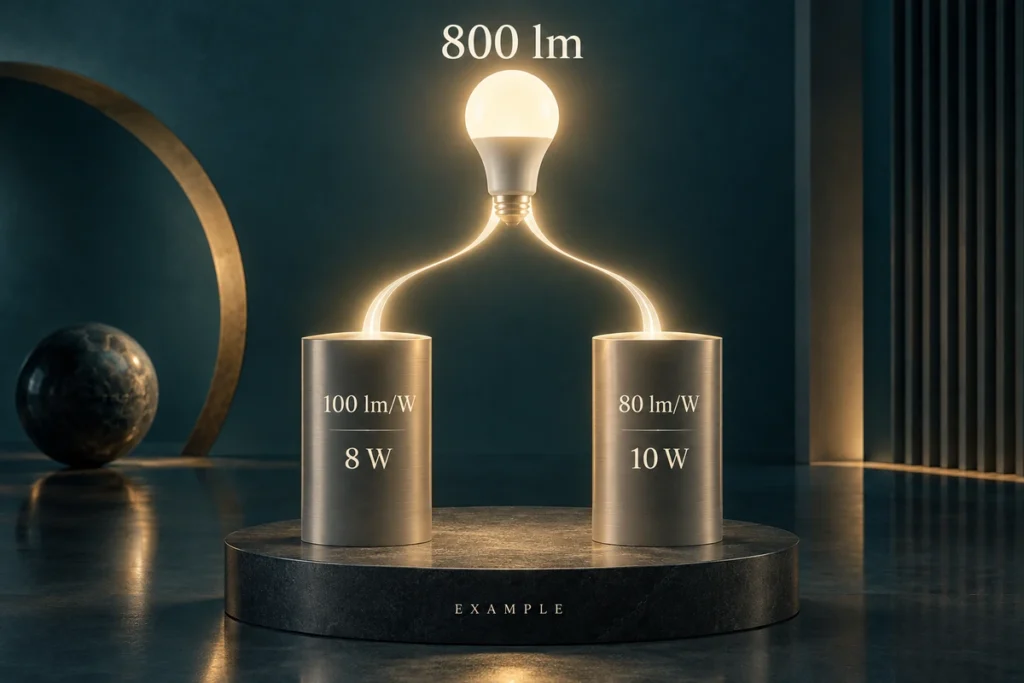
For an LED producing 800 lumens at an assumed 100 lm/W, the input power is 800 ÷ 100 = 8 W. At a hypothetical 80 lm/W, the same output would require 10 W. These are conditional calculations, not a universal 800-lumen LED rating. Use the actual product’s declared input power when it is available.
Watts to Lumens
Light output (lm) = input power (W) × luminous efficacy (lm/W)
A hypothetical 10 W product at 120 lm/W produces 1,200 lm. A conversion tool that uses a preset efficacy gives an estimate based on that assumption. Check the efficacy value before using its result to compare products.
How Many Lumens Replace an Incandescent Bulb?
For a traditional incandescent replacement, use the old wattage as a starting reference and choose an LED with an appropriate lumen output. These values come from ENERGY STAR, the efficiency program run by the U.S. Environmental Protection Agency.
| Traditional incandescent bulb | Approximate light output to look for |
|---|---|
| 40 W | 450 lm |
| 60 W | 800 lm |
| 75 W | 1,100 lm |
| 100 W | 1,600 lm |
These are approximate bulb-replacement references, not a fixed conversion between lumens and LED input watts. A label such as “60 W equivalent” describes a traditional replacement class, not a 60 W draw. Read the actual input wattage, and check that the lamp is suitable for the existing fixture.
Why Compare Complete Fixtures in the Same Configuration?
Chip, lamp, and fixture ratings measure different things. Only figures from one configuration describe the product you will receive.
Chip, Lamp, and Fixture Figures
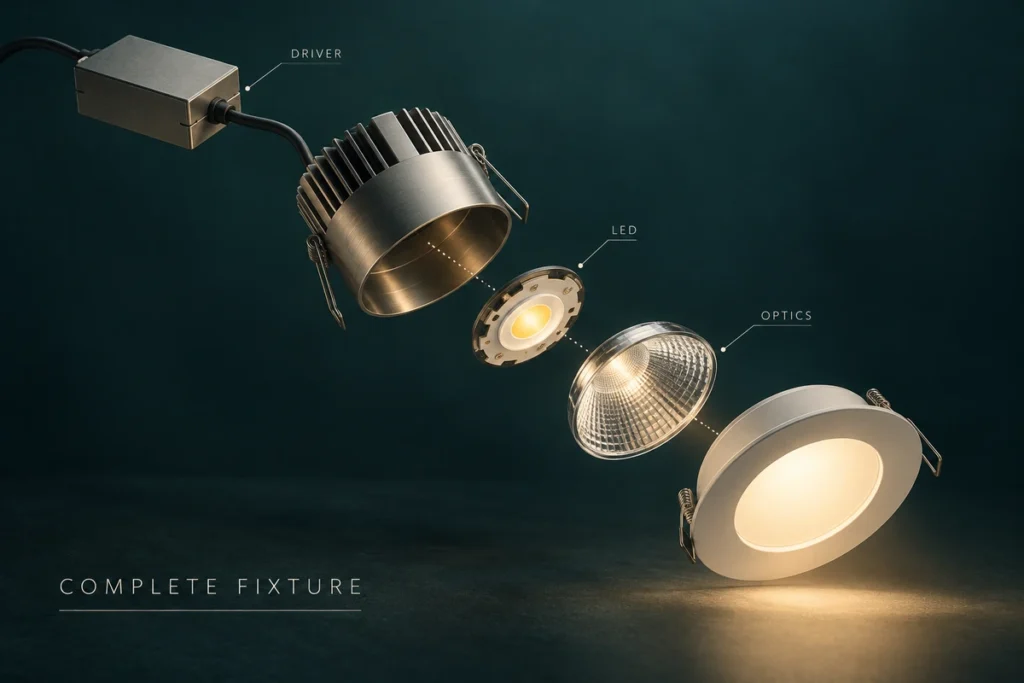
An LED chip or package is a component; a lamp is a light source such as a replaceable bulb; a luminaire is the complete fixture. A chip’s lm/W rating cannot stand in for the complete fixture’s efficacy. DOE’s fact sheet on LED efficiency attributes the gap to thermal effects, driver losses, and optical inefficiencies.
For an integrated LED fixture, compare emitted fixture lumens with total fixture input power, including the driver. If an external driver supplies the fixture, confirm that the quoted input power includes it. For a replaceable bulb, its lumen rating describes the bulb. The assembled fixture’s optics and shade can change how much light leaves it.
Details That Must Match
| Detail to match | Why it matters |
|---|---|
| Exact model and output setting | A family name or maximum output may describe a different version |
| Color temperature | Compare the selected light appearance, not a different catalog option |
| Color rendering index (CRI) | Keep the required color-rendering specification in the comparison |
| Optic, diffuser, or shade | Compare the assembly that will actually be supplied |
| Driver and dimming condition | Pair lumens and watts measured at the same operating condition |
CRI describes color rendering, and color temperature describes the light’s color appearance. Neither is a lumen rating. Keep these choices fixed when comparing alternatives, since a higher CRI specification can change efficacy and delivered lumens.
A specification pairing maximum lumens from one configuration with minimum wattage from another describes no single operating condition. DOE’s guide to IES LM-79 reports notes that the test covers one specific configuration of a complete lamp or luminaire. Ask for the corresponding figures for the exact version you intend to order.
Why Can Equal Lumens Light a Space Differently?
Equal lumen ratings mean equal total output, not equal illumination at the working surface. Illuminance, measured in lux or foot-candles, is the light arriving per unit area. The fixture’s distribution, mounting position, and distance determine where its output goes. A pendant over a table and a sconce on a wall can perform different jobs at the same lumen rating.
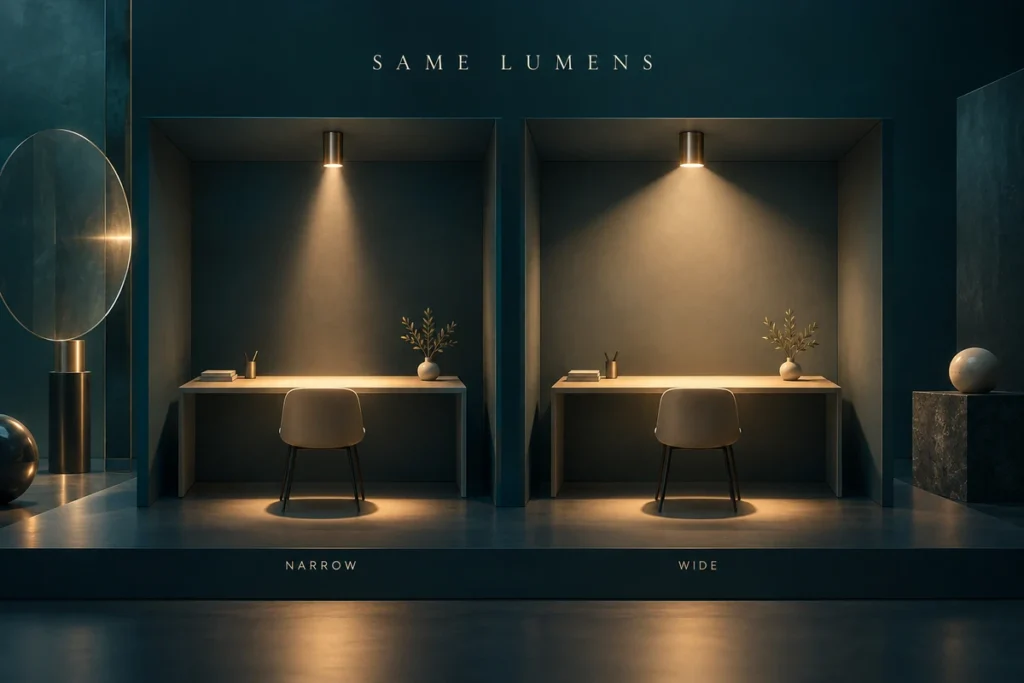
DOE’s discussion of application efficacy explains why lamp or luminaire efficacy alone does not describe the effectiveness of a lighting installation. For a proposed replacement, compare the photometric distribution and mounting height as well as total output. In an office package, review the substitution together with the fixture schedule and ceiling-plan coordination.
How Do You Turn the Comparison into a Lighting Schedule?
Bring the comparison into the specification before production. Record each fixture’s light output and input power beside its model, optic, finish, and control requirements. When a custom fixture changes size, shade, or arrangement, request data for that configuration rather than figures from a catalog image.
At OKBuild, lighting is part of our manufacturing range, with decorative and functional fixtures produced through our own or directly operated production lines. Send your fixture schedule, use locations, quantities, mounting heights, and existing lumen and wattage data with your project inquiry. Include any fixed color or control requirements. Final installation requirements stay with the project’s lighting and electrical professionals.
FAQ
How Do I Calculate Electricity Use and Cost from Watts?
Multiply input power by operating hours, then divide by 1,000 to convert watt-hours to kilowatt-hours (kWh). A hypothetical 20 W fixture running for 1,000 hours uses 20 kWh, or $3 at an assumed rate of $0.15/kWh. This simple calculation excludes other bill charges and assumes constant input power.
Does a 50% Dimmer Setting Mean Half the Power?
Do not assume it does. DOE research on 0-10V LED streetlight controls found light output and input power hard to predict from the control voltage alone. For the proposed fixture, request output and power data at your planned dimmed setting, plus confirmation of control compatibility.