


Choose Low-E glass against the performance and appearance targets for the complete glazing assembly. Those targets depend on the building climate, facade orientation, window area, frame system, insulating glass unit, and project requirements.
For a commercial comparison, set the target U-factor, solar heat gain coefficient, and visible transmittance before comparing products. Then compare hard-coat and soft-coat Low-E glass, confirm the coating surface and glass make-up, and review calculations, product data, and full-size visual samples against the same criteria.
What Does Low-E Glass Do in a Commercial Glazing System?
Low-E glass uses a low-emissivity coating to reduce radiative heat transfer through the glazing while allowing visible light to pass. Coatings can be tuned for lower, moderate, or higher solar gain and for different daylight levels, so they affect both thermal and optical performance. The coating alone does not establish the performance of the complete window.
Whole-window performance also depends on pane count and cavity, gas fill and spacer, frame and edge conditions, glass dimensions, and installation. A lower center-of-glass value cannot stand in for the whole-window result. Commercial buyers should compare values from the same make-up and calculation or certification basis so that quotations describe comparable assemblies.
Low-E coated glass and applied window film are separate products. A factory coating is part of a defined glass product and may need protection inside an insulating glass unit (IGU). Retrofit film has its own substrate limits, optical effects, installation requirements, and warranty. Treating them as interchangeable can change the technical scope after pricing.
Which Performance Numbers Should Drive the Coating Choice?
Review U-factor, solar heat gain coefficient (SHGC), and visible transmittance (VT) as a set. The three values describe heat transfer, solar gain, and daylight. Add reflectance and color data when facade appearance is part of the decision.
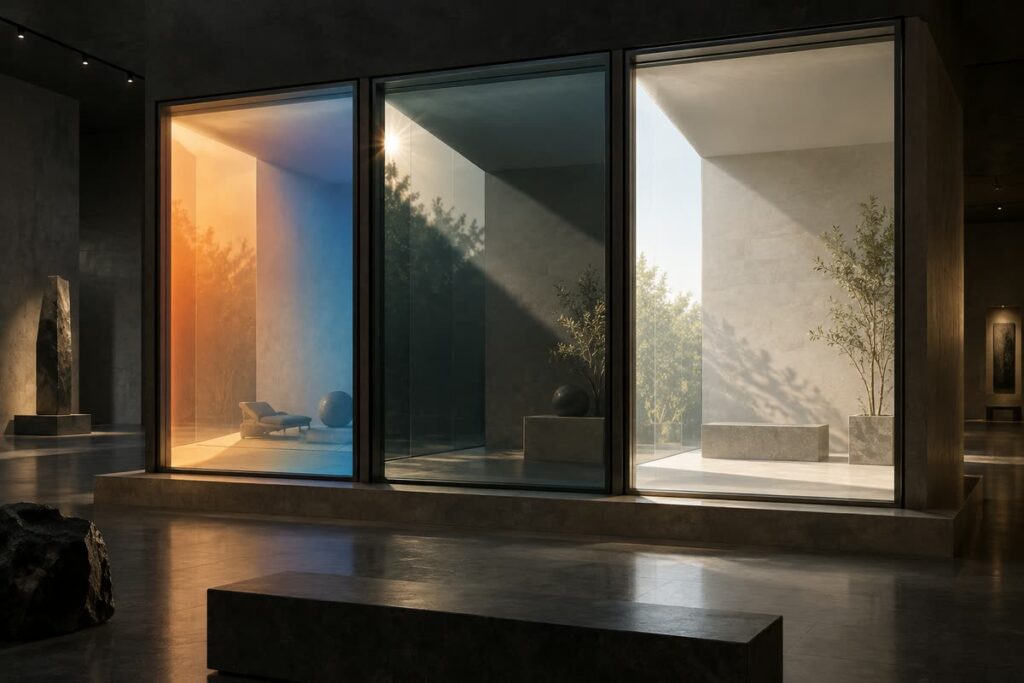
U-Factor and Insulating Performance
U-factor measures heat transfer through a fenestration product. A lower value indicates less heat flow under the stated rating conditions. NFRC reports U-factor for the whole product, including frame and spacer effects, while some glass data sheets report center-of-glass values. Identify the required basis before comparing products.
A low-emissivity coating can lower heat transfer through the glass, but frame, edge, cavity, gas fill, and pane count still affect the assembly result. (NFRC, “What Does the NFRC Label Tell You?”)
Solar Heat Gain Coefficient
SHGC is the fraction of incident solar radiation admitted through the product, both directly and as absorbed heat released inward. A lower number admits less solar heat.
Low SHGC may help control cooling loads on exposed facades in warm climates; a higher SHGC may suit a project that benefits from modeled winter solar gain. Set the target from the project energy and comfort strategy, rather than from a universal “lower is better” rule. (NFRC; Guardian Glass, “Low-e Glass.”)
Visible Transmittance and Appearance
VT measures how much visible light passes through the product. Higher VT admits more daylight, but the target still depends on window area, shading, room depth, glare control, interior use, and the lighting design. The coating and glass substrate can change exterior reflectance, interior reflectance, color, and the view from oblique angles.
Compare performance data with a full-size sample because a small hand sample may hide facade-scale color shifts and reflections. When a VT change affects daylight assumptions or glare control, coordinate the glazing decision with the commercial lighting package. Use consistent room-use and control assumptions when reviewing daylight and electric light.
How Do Hard-Coat and Soft-Coat Low-E Glass Differ?
Hard-coat and soft-coat Low-E glass are different manufacturing families. The labels describe how the coating is applied. A commercial specification still needs the exact product, glass make-up, performance data, processing limits, and approved appearance.
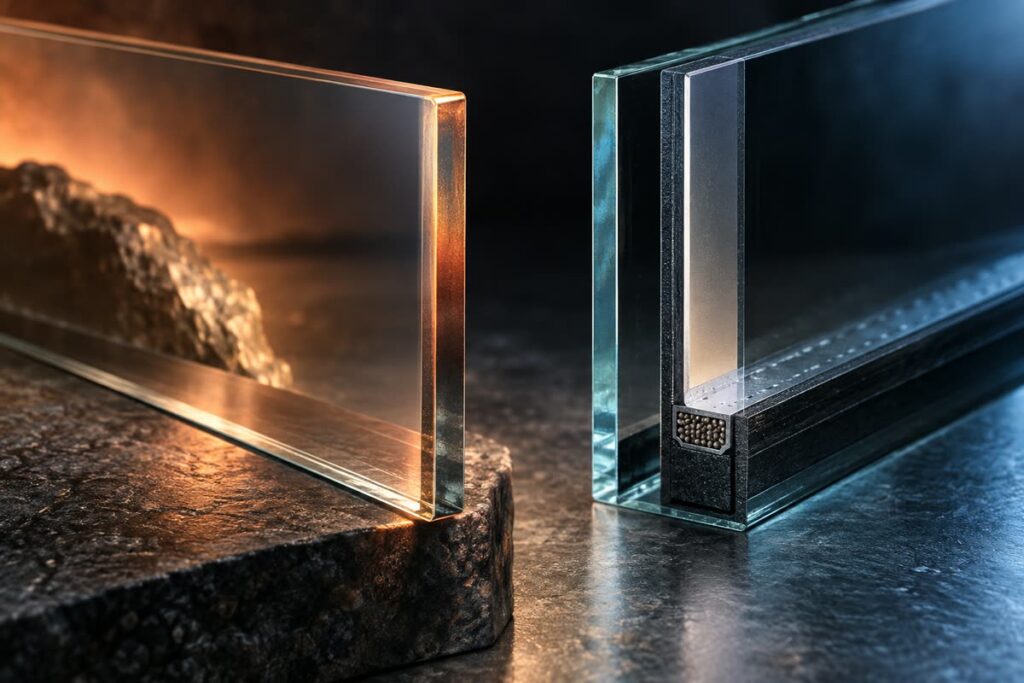
Pyrolytic Hard-Coat Glass
Pyrolytic Low-E, commonly called hard coat, is deposited during float-glass manufacturing while the glass is hot. The coating bonds to the glass and is generally more durable during handling than a sputter coating.
Some hard-coat products may be used where the coated surface is exposed or where monolithic glazing is required, but that permission must come from the selected manufacturer’s processing and application guidance. (Guardian Glass, “Expert Series: Energy Performance and Low-E Coatings”; Viridian Glass FAQs.)
Durability alone does not establish the required energy or optical result. Request the proposed make-up’s declared U-factor or U-value basis, SHGC, VT, reflectance, color, and emissivity. Confirm the available substrates, coating-surface rules, heat-treatment compatibility, and warranty conditions.
Sputter-Coated Soft-Coat Glass
Sputter-coated Low-E, commonly called soft coat, is applied to formed glass in a magnetron sputter vacuum deposition process. The process can produce high visible light transmission and low solar gain, including solar-control coatings for commercial facades. The coating usually needs protection on a sealed cavity surface within an IGU because exposure can damage or degrade it. (Guardian Glass; Viridian Glass FAQs.)
Soft-coat products span several performance classes. Single-silver, double-silver, triple-silver, and other product designs can differ in SHGC, VT, reflectance, color, and fabrication rules. Edge deletion, heat-treatment options, size limits, and other processing requirements also vary. Compare the exact proposed product and assembly instead of treating “soft coat” as a complete specification.
How Should Climate, Orientation, and Window Area Change the Selection?
Set the performance target by elevation or glazing zone when solar exposure and window area differ materially. A single building-wide coating may simplify purchasing and visual control, but it can also over-control daylight on one facade or admit too much solar heat on another.
| Project condition | Coating decision to test | Required project input |
|---|---|---|
| Warm climate or cooling-dominated space | Lower SHGC while retaining the VT and appearance needed for the space | Energy model, facade orientation, shading, window-to-wall area, and cooling strategy |
| Cold climate or heating-dominated space | Low U-factor with an SHGC that matches the modeled value of winter solar gain | Heating strategy, orientation, external shading, and seasonal energy model |
| Large west-facing glazed area | Stronger solar control, glare review, and possible elevation-specific make-up | Hourly sun exposure, room use, shading, interior finishes, and comfort criteria |
| Deep floor plate needing daylight | Higher useful VT without exceeding solar and glare limits | Daylight study, room depth, lighting controls, and glare review |
| Mixed facade colors or substrates | One visual family or approved elevation-specific variants | Exterior renderings, substrate selection, coating samples, and viewing conditions |
The facade consultant and mechanical or energy team should test candidate make-ups against the same model assumptions. Local energy code establishes minimum or maximum requirements, and the owner and design team may set tighter comfort or appearance criteria. A supplier data sheet supports the comparison, but it does not set the project target.
What Should the Whole Glazing Make-Up Confirm?
Specify the Low-E coating as part of a complete glass and frame make-up. That keeps the coating tied to the surfaces, panes, processing, and system details behind the declared result.
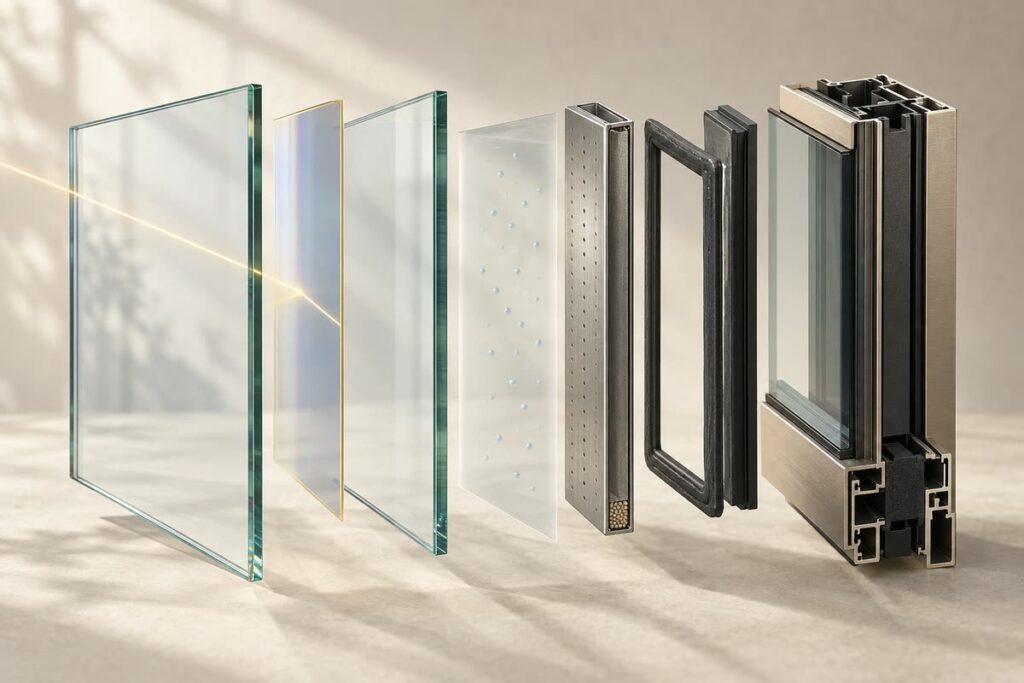
Coating Surface and Insulating Glass Unit
Number the glass surfaces from exterior to interior, then record the coating position using the fabricator’s approved nomenclature. The same Low-E product can perform differently on another surface, so the glazing schedule and approved shop drawings need to show the same location.
For the complete insulating glass unit (IGU), record pane thickness and substrate, cavity width, gas fill, spacer and sealant. Add any frit, tint, laminate, or second coating. Guardian Glass notes that surface 2 is often used for solar-control Low-E because it reflects part of the incoming solar energy before that energy enters the glazing. The final position remains product- and make-up-specific.
Use the fixed-window specification to coordinate the coated glass with the frame type and opening mark. The schedule and shop drawings should identify the same glass build and coating surface. Otherwise, the approval does not cover the proposed assembly.
Heat Treatment, Lamination, and Edgework
Confirm the treatment for each lite: annealed, heat-strengthened, fully tempered, laminated, or another safety-glazing make-up. Before releasing sizes or cutouts, have the glass manufacturer and fabricator confirm compatibility with the required tempering, bending, laminating, ceramic frit, edge deletion, storage, and fabrication route.
Review coating compatibility separately from safety and fallout protection, structural loads and thermal stress, and any fire-rated, bird-friendly, or local code requirements. A Low-E coating does not prove safety, structural capacity, or code compliance. Record the product standard, calculation, test, mark, and approval path required for the installed location.
Frame, Spacer, Gas Fill, and Edge Effects
Compare whole-product thermal performance using the approved frame and IGU assembly, not isolated center-of-glass data. Guardian Glass identifies gas fill, warm-edge spacers, thermally broken frames, and additional panes as separate ways to improve insulating performance.
Changing the frame, spacer, cavity, gas fill, pane count, glass size, or edge construction may require a new check of the quoted thermal value. Review weather performance separately through air-leakage submittals, water penetration, structural testing, drainage, sealants, and installation interfaces. These assembly checks remain separate from center-of-glass coating data.
What Should Be Reviewed Before Low-E Glass Is Approved?
Approve the declared performance and the visible result together. A reported number does not resolve color, reflectance, viewing-angle, processing, or facade-uniformity questions.
Performance Calculations and Product Data
Use one comparison sheet for each candidate make-up. Record the manufacturer and product code, glass substrates and thicknesses, coating surface, cavity, gas fill, spacer, and frame series. Then state the U-factor basis, SHGC, VT, exterior and interior reflectance, and any light-to-solar-gain ratio used by the designer.
Add the software, standard, report, certificate, or laboratory basis, and identify whether the values are center-of-glass, center-of-panel, or whole-product. Check availability and size limits separately from heat-treatment, lamination, edge-deletion, quality, sealant, warranty, and fabricator requirements. If a quotation changes an input, require a revised calculation and comparison before carrying values into a different assembly.
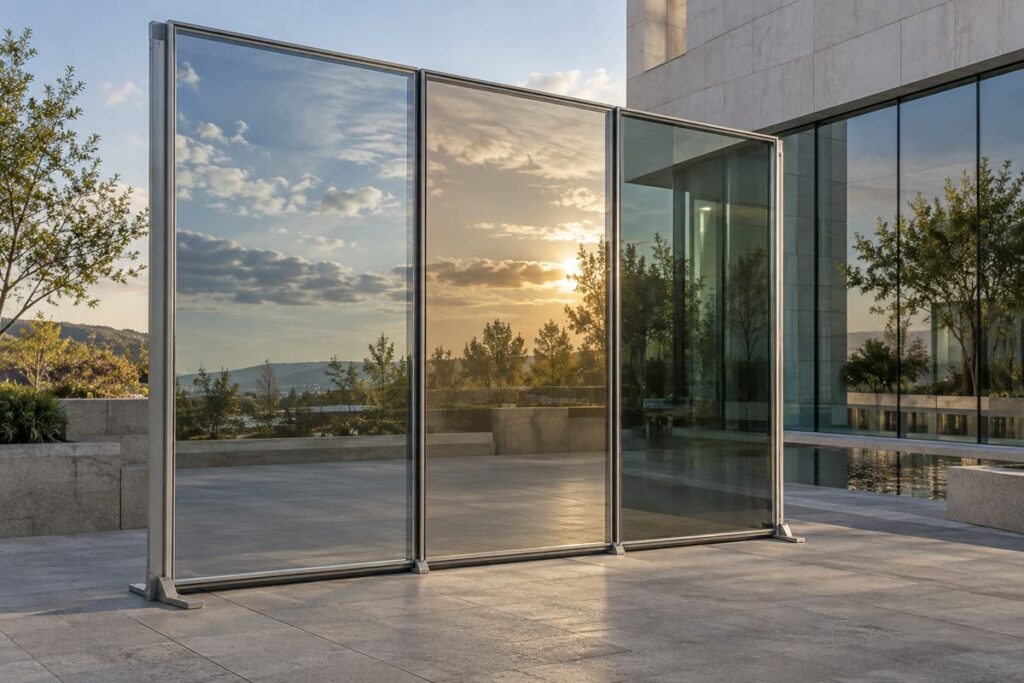
Full-Size Visual Mock-Up and Approval Sample
Review full-size glass under representative sky, sun, background, interior lighting, and viewing distances. Compare proposed variants from both sides at normal and oblique angles. For an extension or replacement, include retained facade glass.
Record the product codes, substrates, make-ups, coating surfaces, heat treatment, sample size, viewing conditions, date, reviewers, and approved limits. The approval applies only to the conditions recorded. Production variation, glass size, heat treatment, background, adjacent materials, and viewing angle can affect appearance. Set the visual-quality reference and inspection method before production, then route substitutions and batch changes through the same approval record.
What Should Buyers Put in the Low-E Glass Schedule?
The schedule should let bidders price the same glazing and let reviewers trace each opening to its approved performance and appearance reference.
| Schedule field | What to record | Decision supported |
|---|---|---|
| Glazing mark and location | Elevation, level, zone, opening type, and quantity basis | Links the coating to the correct facade condition |
| Complete make-up | Pane order, substrate, thickness, treatment, laminate, cavity, gas, spacer, and coating surface | Prevents partial or changed assemblies from being compared |
| Performance criteria | Whole-product or center-of-glass basis, U-factor, SHGC, VT, reflectance, and any project-specific limits | Creates a common technical comparison |
| Product evidence | Manufacturer, product code, data sheet, calculation, report, certificate, and revision | Shows what supports each declared value |
| Visual reference | Approved full-size sample or mock-up ID and viewing criteria | Controls color, reflectance, and facade consistency |
| Processing limits | Size, tempering, lamination, edge deletion, frit, bending, sealant, and handling conditions | Confirms that the selected coating can be fabricated as drawn |
| Interfaces and responsibilities | Frame series, sealant, shading, local review owner, installer, inspection point, and substitution process | Keeps coating approval tied to the installed system |
Issue the same schedule and drawings to every bidder. When comparing direct-sourcing quotes, require each quotation to state the proposed make-up, exclusions, alternates, supporting evidence, quantities, and delivery basis. A line that says only “Low-E included” is incomplete because it cannot support a technical or commercial comparison.
How Can OKBuild Support the Glazing Package?
The product categories page helps identify where the glazing package interfaces with frames, shading, lighting, and adjacent finishes. During procurement and review, assign manufacturing, testing, and approval responsibilities to the correct package.
Send elevations, opening schedules, target performance, glass make-ups, appearance references, quantities, and destination requirements with the inquiry. Within the confirmed supply agreement, OKBuild can review the requested scope and prepare specification and quotation questions. Local professionals retain design, energy, code, structural, installation, and acceptance responsibility.
Frequently Asked Questions
Is Low-E Glass the Same as Tinted or Reflective Glass?
No. Low-E describes a coating that reduces radiative heat transfer. Tinted glass absorbs selected parts of the solar spectrum, while reflective products are designed for higher visible or solar reflectance. A product can combine a Low-E coating with clear, low-iron, tinted, or reflective-looking glass. Compare SHGC, VT, reflectance, color, and make-up instead of relying on one category label.
Can a Low-E Coating Be Added After Installation?
A factory-applied Low-E coating is part of the glass product and cannot be added to an installed commercial window. Retrofit window films can be applied to some existing glazing, but they are separate products. Before using a film, confirm glass compatibility, thermal-stress risk, edge condition, seal and warranty effects, optical appearance, fire or code requirements, installation method, and expected performance for the existing assembly.
Does Low-E Glass Reduce Ultraviolet Transmission?
Many Low-E glass make-ups reduce some ultraviolet transmission, but the amount varies by coating, substrate, tint, laminate, and full assembly. Use the selected product’s spectral or ultraviolet-transmission data when fading control matters; a generic percentage is not reliable. Coordinate that data with interior materials, artwork requirements, and any separate shading strategy.
Can One Building Use Different Low-E Coatings by Elevation?
One building can use different Low-E coatings by elevation when energy, comfort, glare, or daylight analysis supports the difference and the design team accepts the visual result. Assign each elevation or zone a distinct glazing mark. Compare exterior color and reflectance together so that an energy-driven change does not create an unintended patchwork facade.
A full-size mock-up should include adjacent variants when more than one coating will remain visible from the same viewpoint.
How Should Replacement Low-E Units Match an Existing Facade?
Start with the original glass schedule, product data, coating surface, pane make-up, heat treatment, tint, and approved sample, if those records exist. Inspect retained units from representative interior and exterior viewpoints. Then compare full-size replacement samples under similar conditions.
Product names and nominal performance values cannot guarantee a visual match across manufacturers, coating generations, batches, or weathered existing glass.