

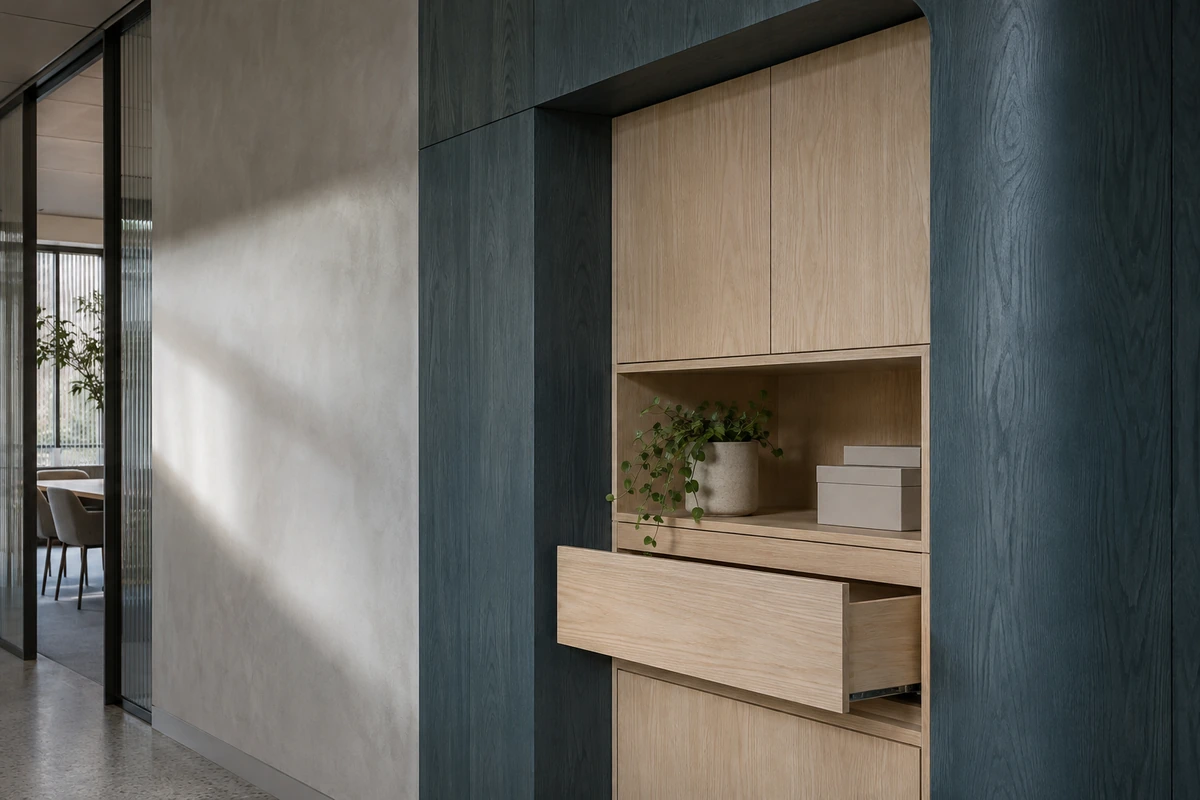
In a commercial fit-out, casework means cabinet assemblies, and architectural millwork is the broader scope of shop-made woodwork that can include those cabinets alongside wall panels, trim, and counters. A cabinet can be both casework and part of a millwork package. On the drawings, the distinction helps you separate what belongs to the cabinet from the woodwork that has to fit around it.
What Do Millwork and Casework Cover?
Casework is defined by its cabinet box, while millwork is defined by the place in the building it is made to fit.
| Casework | Architectural millwork | |
|---|---|---|
| Built around | A cabinet box that supports drawers and shelves and carries the doors and hardware | Woodwork made for a specific interior, including the cabinets it encloses |
| Typical items | Base and wall cabinets, pantry runs, minibar cabinets, storage walls | Paneled walls, reception counter fronts, trim, headboard walls |
| Current AWI standards | ANSI/AWI 0641-2019 Architectural Wood Casework; ANSI/AWI 1232-2022 Manufactured Wood Casework | ANSI/AWI 0642-2024 Wood Paneling; ANSI/AWI 0622.0646-2024 Millwork and Wood Trim |
Where the Two Overlap
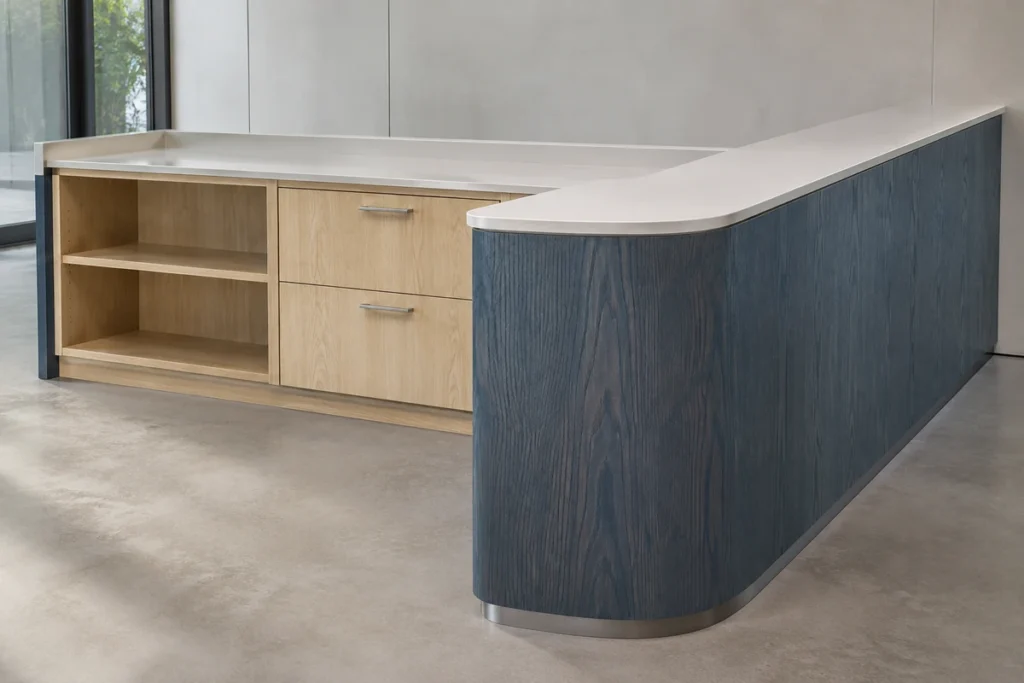
A reception counter shows the overlap. It can combine cabinet boxes on the staff side with a shaped front and end panels that carry the design around the corner. A project can put the whole counter in its millwork scope even though the storage inside it is casework. A paneled lobby wall beside it still needs its own layout for joints, corners, and the points where it meets the floor or ceiling.
Custom and Manufactured Casework
A bank of matching office pantry cabinets can use standard modules. A wall-to-wall cabinet made to suit an irregular opening is still casework, even if every unit is made to order and fastened to the building. Custom runs often reuse components too. In a staff pantry, the drawer units can stay the same while the cabinet at one end changes width. The cabinetmaker then reuses the drawer detail and issues a separate detail for the end cabinet.
Check which standard the specification cites before pricing. AWI’s ANSI/AWI 0641-2019 took effect on June 1, 2020, replacing the casework section of the 2014 Architectural Woodwork Standards. It covers casework designed and supplied for a specific project under MasterFormat Division 06 and excludes Division 12 products. Manufactured casework now has its own standard, ANSI/AWI 1232-2022. A specification that still cites the 2014 edition should be updated before bidders interpret it differently.
How Both Fit Into the Same Hotel Guestroom
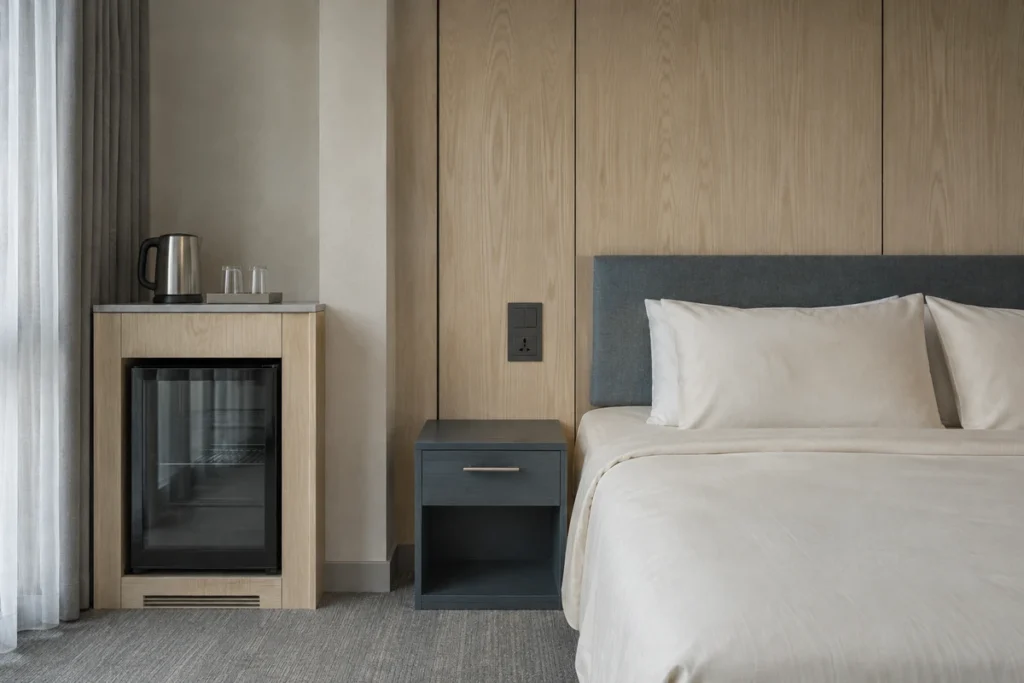
In one guestroom, the minibar cabinet behaves like casework and the headboard wall like millwork, and the two meet where they share a finish.
Minibar Cabinet: Casework Repeated by Room Type
A hotel can repeat the same minibar cabinet across guestrooms with the same appliance and layout. Where the finished opening is a little wider, a filler strip can close the gap between the cabinet and the wall. Keep the cabinet width constant if the approved filler detail still gives the door room to swing and leaves access to service the appliance. A mirrored room can need a door that opens the opposite way at the same width. Mark that variant on the room schedule if the hinge holes move to the other side.
Headboard Wall: Millwork Fitted to Each Room
The headboard wall starts from the room, not from a standard box. Work out where the panel joints land against the bed, switches, and outlets, because a joint centered on the bed might pass through an outlet opening. Show both on the same elevation so the designer and electrician can agree where the joint and outlet should land before the panels are cut.
Where They Share a Finish
The minibar end panel and the headboard wall may call for the same finish. Review those surfaces together and show where the grain should carry through a joint or change direction, especially where a panel turns a corner. If a column narrows the opening enough to change the cabinet box, give that cabinet its own item code. The shop can then identify which rooms need the narrower unit.
How Should the Two Scopes Appear on Drawings?
Draw the shared edge once and reference it from both scopes, so every bidder prices the same boundary.
Mark the Junction on the Elevation and Section
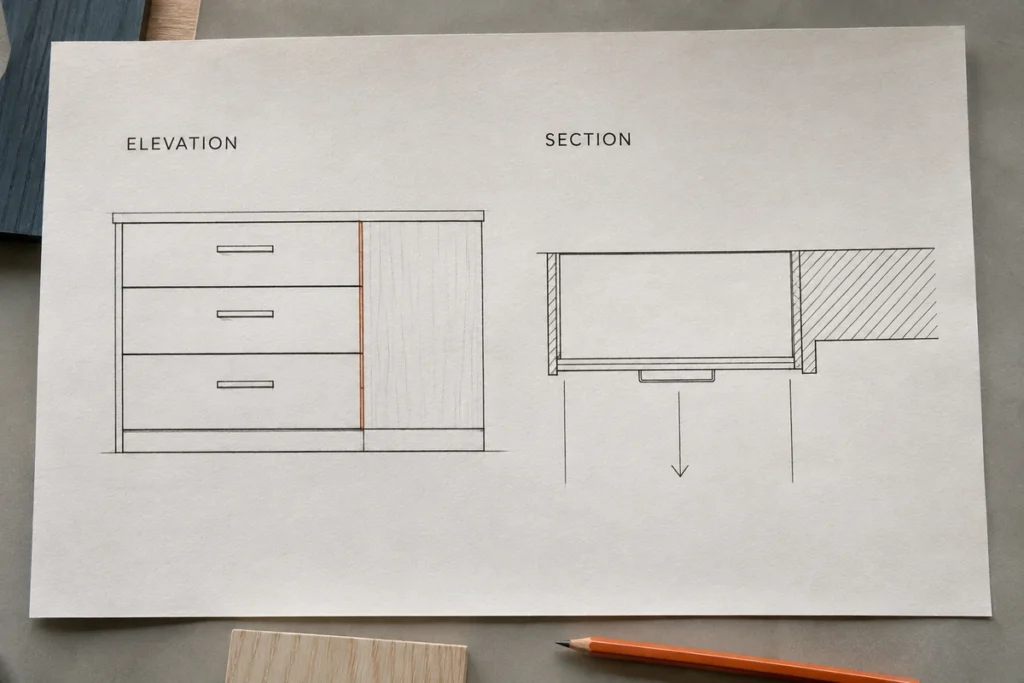
Use one room elevation to show where the cabinet stops and the surrounding woodwork starts. AWI’s submittal requirements (AWI 100) ask casework shop drawings to show construction, joinery, and attachment to walls and floors. Wall-panel drawings show panel joints, corner joints, and attachment. Cross-reference the two details at the shared edge. Where a wall panel projects past the cabinet face, add a section through the junction. It shows whether the panel interferes with a drawer pull or blocks a removable cover.
Give Each Piece Its Own BOQ Line
Use the same item codes on the drawings and the bill of quantities (BOQ). A cabinet code can cover the box, doors, and hardware, with a separate line for the adjoining wall panels. If the cabinet manufacturer also makes the filler and the finished end, assign those pieces to that scope by name. A finished end drawn as part of a continuous surface is easy to miss when each bidder assumes the other is supplying it.
Flag Provisional Dimensions
Confirm the finished opening and service positions with the contractor or installer responsible for site measurements, and mark the dimensions that are still provisional. The agreed millwork package should also assign wall backing, site fitting, and installation to the parties doing that work. If the measured wall differs from the drawing, check the shared detail before the shop cuts a new panel or changes the cabinet width.
When Does One Manufacturer Make Sense?
One manufacturer makes sense when a cabinet and a wall panel share a visible joint, because both pieces can then be made from one coordinated drawing. Cabinetry and architectural millwork both sit in OKBuild’s core manufacturing base. We make custom cabinetry, wall panels, and reception counters to project drawings. On a hotel package, the cabinet runs can be produced by room type alongside the panels that vary from room to room.
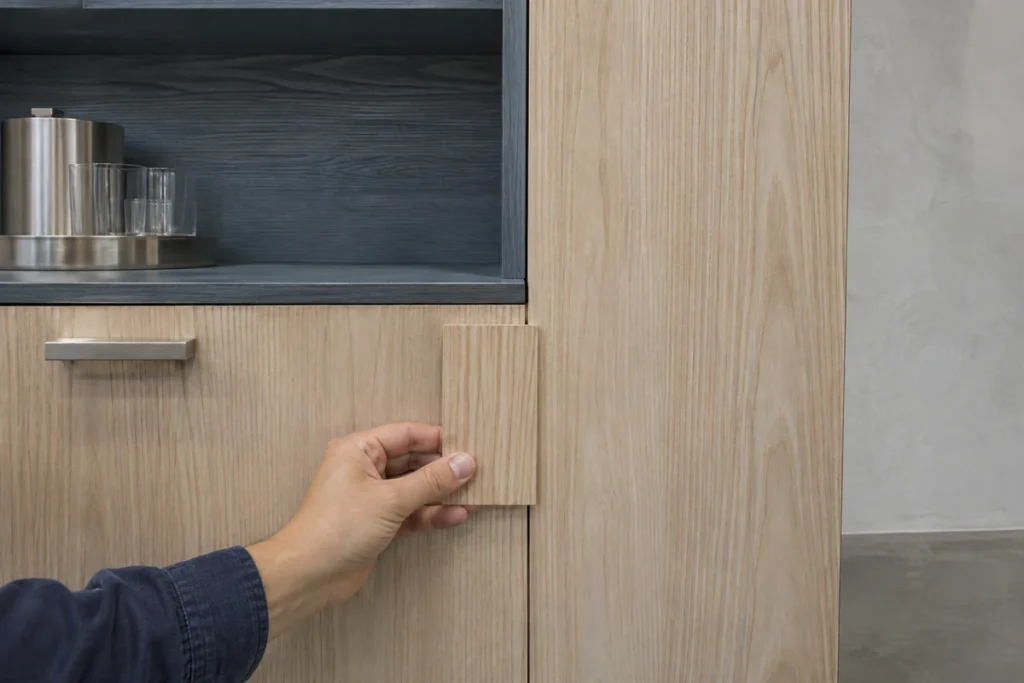
A finish sample settles color and sheen. When the order includes first-article approval, we make a first unit for review before the production run. If that unit includes the finished end or adjoining panel, the joint can be checked at full size. For repeated guestrooms, an optional 1:1 mock-up shows the minibar cabinet and headboard wall together, and in-process inspection then checks dimensions, finish, and assembly against the approved references.
Price Repeated and Room-Specific Work Separately
A room elevation that shows the shared joint lets us price the repeated units apart from the room-specific work. Add the BOQ and finish reference, point out any rooms where the opening differs from the typical layout, and request a manufacturing review.
Frequently Asked Questions
Is Modular Casework Less Expensive Than Custom Millwork?
It can be, when the standard cabinet fits the opening and meets the required finish and hardware specifications. Compare quotes at the same room count against the same installed scope, adding any finished ends, fillers, or site fitting a bidder excludes. Spread any one-time drawing or setup charge over that room count.
Does a Freestanding Hotel Dresser Go in the Millwork Package?
Usually not, because a freestanding dresser typically goes on the furniture, fixtures, and equipment (FF&E) schedule as a hotel casegood. If fixed panels or a built-in surround enclose it, list the dresser and the surround separately so bidders know which package includes each piece.
Sources
- What’s the Difference Between Millwork and Wood Casework?, AWI Quality Certification Program: casework as a type of millwork, custom and modular casework, and when standardized units cost less.
- AWI 100 Submittals: Manufacturer/Supplier Responsibility, Architectural Woodwork Institute: shop-drawing content for casework and for wall surfaces in Sections 3.2.3.1 and 3.2.3.2, and the current list of ANSI/AWI standards.
- ANSI/AWI 0641-2019 Architectural Wood Casework: Introduction and Scope, Architectural Woodwork Institute: effective date, replacement of the 2014 casework section, and the Division 06 scope that excludes Division 12 products.