

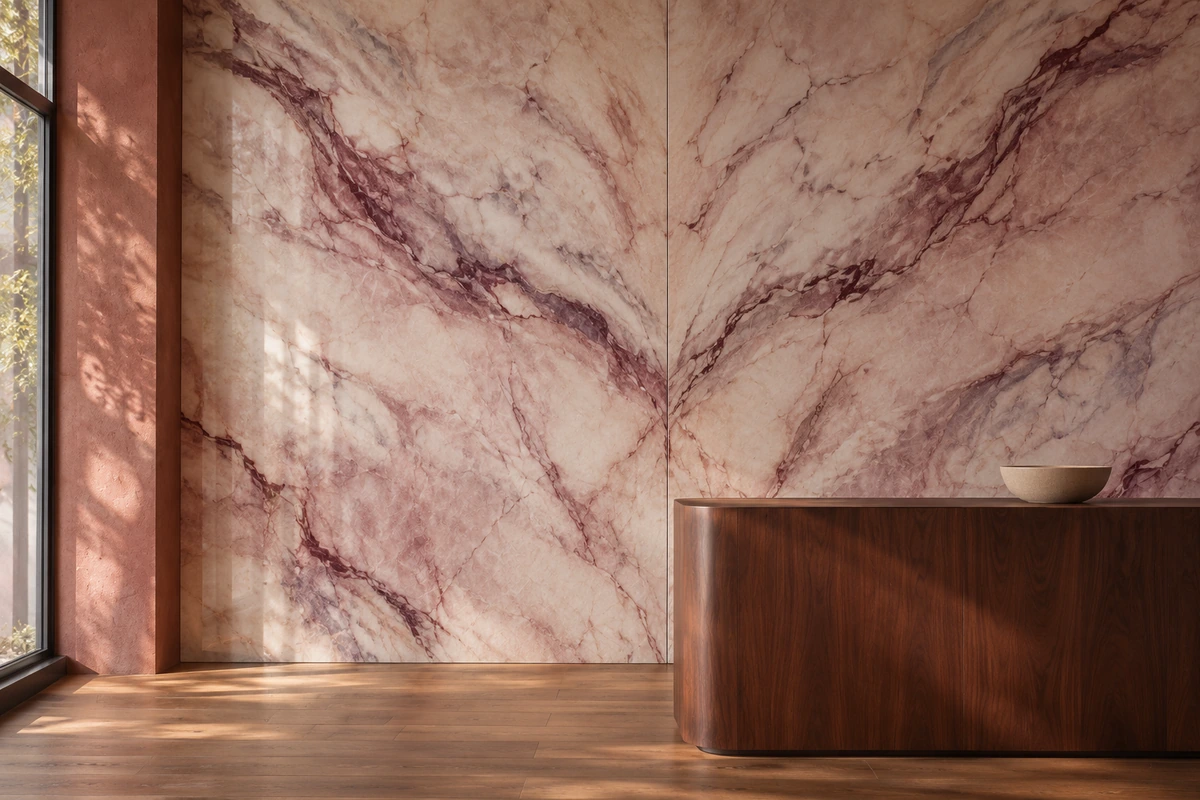
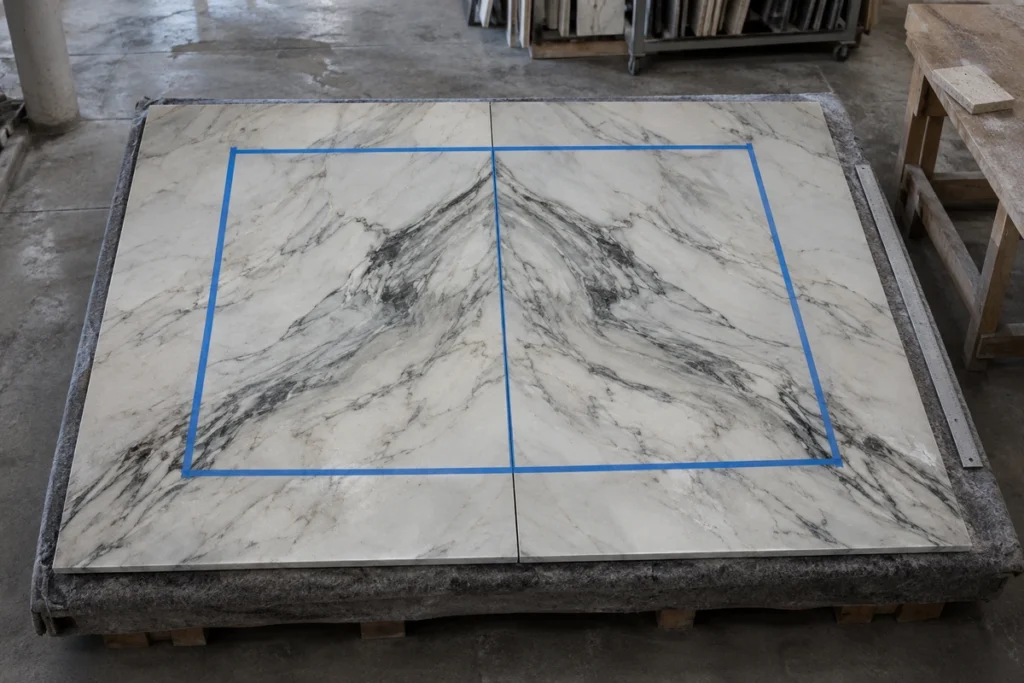
Bookmatched marble uses neighboring slabs whose veins form a near-mirrored pattern across a joint. Planning that pattern means choosing the actual slabs, fitting them to the finished surface, and agreeing on the layout before the workshop starts cutting. A convincing full-slab photograph is only the starting point, because the design still has to work after edges, openings, and panel boundaries are cut.
What Is Bookmatched Marble?
In a bookmatch, the facing surfaces of two neighboring slabs are both polished, so the pair opens like two pages of a book. Use Natural Stone notes that this is usually arranged at the sawyer when the block is cut, not by the fabricator later. The veins reflect around the shared joint, although natural variation remains between the faces. Other matching methods produce a different result, so name the one you want on the drawing:
| Matching method | What you see | Where it is often used |
|---|---|---|
| Bookmatch | Two mirror-image faces reflected around one joint | Lobby walls, reception backdrops, and other wide vertical surfaces |
| Vein match (slip match) | The key veins flow across the seam instead of reflecting | Waterfall edges and countertop returns, where a continuous pattern reads better than a mirror |
| Four-way (quad or diamond) match | Four pieces arranged around a center point | Large feature panels where a central motif suits the space |
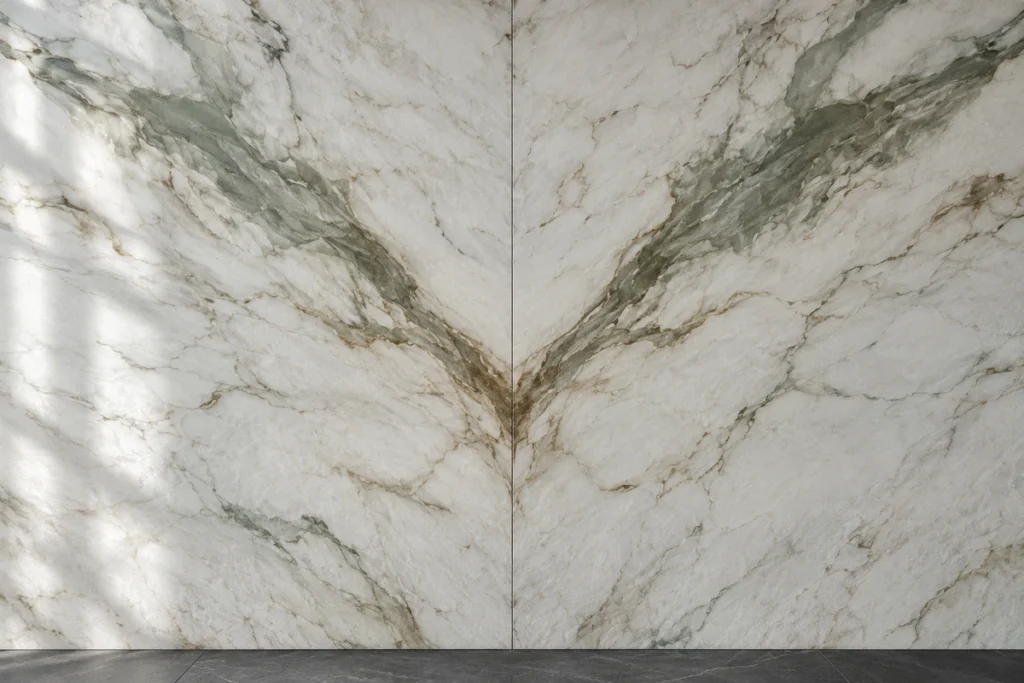
A request for “matching marble” leaves that choice unresolved, especially where a countertop meets a vertical return. Bookmatching is easiest to appreciate across a visible expanse of stone, and its center should follow the part people will actually see. The center behind a reception desk may differ from the centerline of the whole wall. Mirrors, access panels, signs, or a basin opening can also interrupt the composition.
How to Plan Your Slab Layout
Once you know where the stone will go, decide which parts of which slabs will form that surface. Keep the actual slab photographs and the project drawing together as the layout develops. A change to a seam or cutout needs checking against both.
Start With the Slabs You Will Actually Use
Choose the marble variety and finish before reserving a pair. OKBuild’s guide to marble types can help with those material choices, but a small finish sample cannot show the full paired composition. For that decision, you need photographs of both proposed faces, identified by slab number, dimensions, finish, and orientation. Consecutive numbers alone do not establish that the finished faces form a bookmatch.
Ask the workshop to mark usable boundaries and any areas it proposes to trim, repair, or exclude. Any area trimmed from one face also has to come off its mate, so a flaw near the joint reduces both pieces. If the presentation was made by mirroring a single photograph, treat it as an illustration and request images of the actual pair before approval. The quotation should identify those slabs and the reservation period, so a later substitution can be reviewed against a new layout.
Fit the Pattern to the Finished Surface
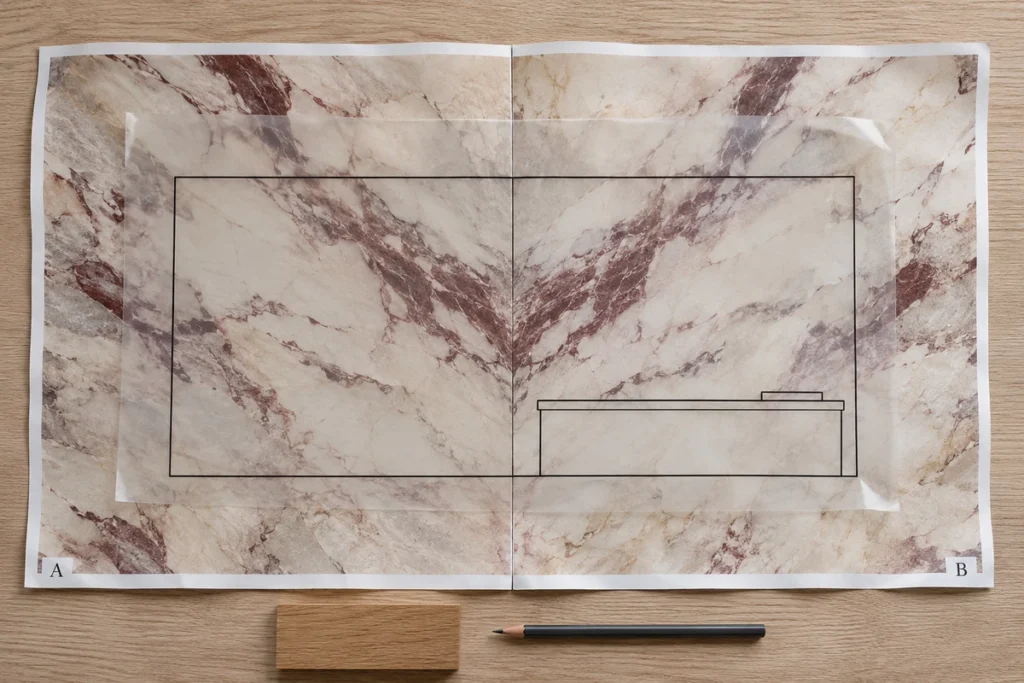
Put the visible surface boundaries on the drawing before deciding where the vein junction should sit. Include adjacent finishes, joints, edge treatments, and openings. A pair can be joined along any of its four edges and flipped left to right or top to bottom. Compare those positions at the same scale, and keep each photographic face tied to its slab ID while you test them.
On a reception wall with a central logo, overlay the logo and desk outlines on the proposed stone. Decide whether the junction should frame the logo or sit clear of it, and check how much of the pattern remains visible above the counter. A full-slab display may look balanced while the finished wall hides its strongest feature behind the desk. Moving pieces on the drawing costs nothing before cutting.
Record the Approval Before Cutting
The approval needs to connect the chosen appearance with a drawing the workshop can act on. Use a dated revision that identifies the selected slabs and finished pieces. A general comment such as “the marble looks good” should never read as permission to cut an unresolved arrangement. The owner’s representative approves the composition, while the appointed designer, fabricator, installer, and local engineer where required resolve dimensions, supports, handling, and installation access.
| What is being approved | What the record needs to show |
|---|---|
| The stone | Slab IDs, selected faces, finish, and accepted visible variation |
| The composition | Piece locations and orientation on the elevation or plan |
| The fabrication | Finished dimensions, seams, specified joint widths, edges, cutouts, and returns |
| The review and release | Required physical review, approval roles, and the drawing revision that authorizes cutting |
Dry Lay the Pieces Before Installation
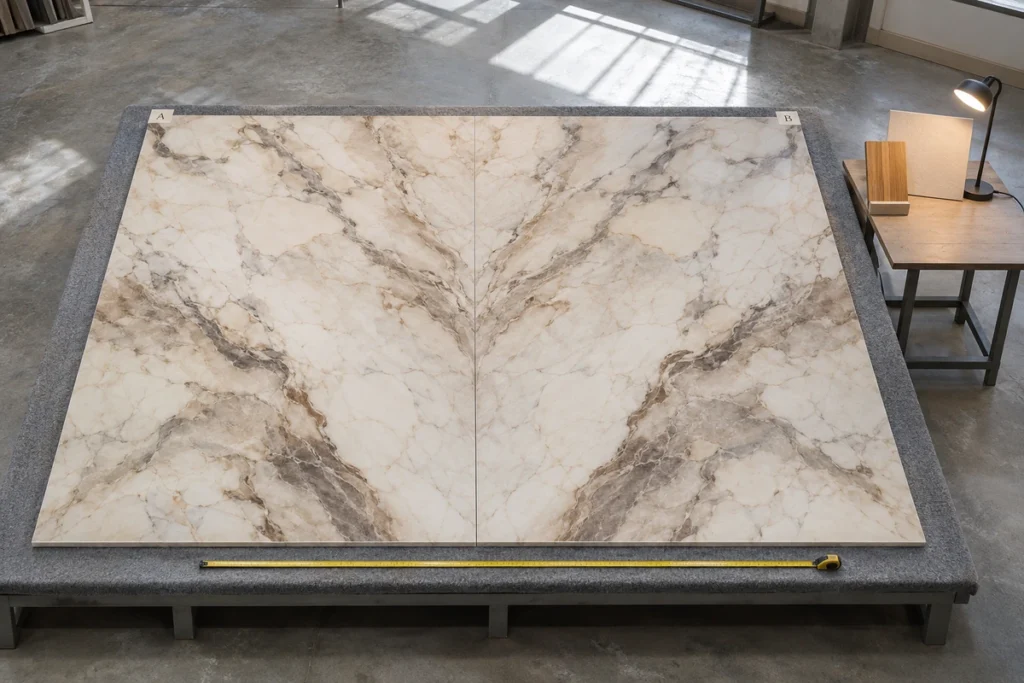
Photographs show the proposed allocation of the pattern, while a dry layout brings the actual slabs or fabricated pieces together for review. Use Natural Stone recommends dry-laying the panels before installation, and the joining edges need to be in near-perfect condition for the mirror to read. Agree what will be reviewed before cutting and what will be checked after fabrication. Where appearance depends on neighboring finishes or project lighting, add suitable samples or a mock-up rather than expecting the slab image to settle that question.
How Layout Decisions Change the Cost
A bookmatched feature is priced by the pair and the finished pieces it yields, which makes a square-foot rate a weak basis for comparison.
Price the Pair, Not the Square Foot
A bookmatch needs two slabs even for a small surface. A lower material rate can still produce a more expensive feature if the composition requires additional slabs or more fabrication. Establish whether the quotation prices whole slabs or finished pieces, and what happens to the remaining material.
Revise the Layout to Fit the Budget
If the first layout exceeds the budget, ask for an alternative priced on the actual slabs. Reducing the feature area or moving a seam may allow a different material allocation, but the revised design needs its own cutting plan. That plan should set the waste allowance, because a standard percentage applied before the pieces are mapped cannot explain the material this arrangement requires.
Compare the Same Scope
Two quotations for custom stonework are only comparable when both cover the same work:
- Fabrication: Finish, edge profiles, cutouts, returns, and the layout reviews included
- Packing and freight: Protective packing and the delivery term to the named place
- Destination tasks: Who handles customs clearance, duties, unloading, storage, and installation
From Approved Layout to Delivery
After approval, the drawing needs to stay recognizable in the finished goods and in the order they reach site.
Carry Piece IDs Through Fabrication
Give each piece an ID that carries through the layout, inspection record, and packing list. Before packing, request photographs showing the fabricated pieces in their approved orientation, with enough detail to compare finish, seams, edges, and openings against the released drawing. A change to the material, orientation, or piece allocation needs a revised review before the affected work proceeds.
Plan the Schedule Around the Pair
Bookmatched slabs generally come from the sawyer, so allow for longer sourcing than for slabs taken from stock. Build the schedule from the required site date through transport, packing, fabrication, and approval. On the packing records, identify matched pieces and their destination areas, and arrange delivery batches around the site’s installation sequence. If final measurements or approval will arrive late, ask for production and delivery dates to be reassessed before committing to the site schedule.
Stone and Joinery Reviewed Together
A bookmatched backdrop usually meets something else we make, such as a reception counter, wall paneling, or vanity cabinets. We make those pieces in OKBuild’s core manufacturing base and coordinate the stone alongside them under our project QC. Shared dimensions, finishes, and delivery priorities then sit on one set of drawings. For custom stone, we review the material, dimensions, edges, cutouts, and layout before fabrication, then check the finished pieces against the approved specification. Slab availability, the checks that apply, and the inspection records are agreed in the quotation and contract.
For a bookmatched feature, start with an elevation or countertop plan that marks the stone. Bring it to a stone package review with the marble reference, approximate quantity, project country, and target delivery date. We will identify missing details before preparing a quotation.
FAQs
Can Sequential Slabs Be Turned Into a Bookmatch?
Sometimes, by polishing the back face of one slab. Use Natural Stone still calls planning for a bookmatch from the start less hassle and more reliable. Ask the supplier whether the pair was cut and finished as a bookmatch before relying on consecutive slab numbers.
Can a Spare Slab Replace a Damaged Bookmatched Panel?
Do not assume it can. A broken slab is irreplaceable, and the whole matched layout may be lost with it. Agree a replacement strategy when selecting the original pair, and treat any proposed replacement as a new layout review.
Can Quartz or Porcelain Slabs Be Bookmatched?
Yes, some manufactured slab collections are produced as matched pairs. Cambria, for example, sells its bookmatched quartz designs only in quantities of two. Some markets restrict engineered stone, as our marble vs. granite guide explains for Australia.
Sources
- Bookmatching: Geology Meets Geometry, Use Natural Stone: polishing the facing surfaces at the sawyer, joining and flipping a pair, vein and four-way matching, trimming both faces, dry-laying before installation, sourcing lead times, and the risk of losing a layout to breakage.
- Cambria Quartz Countertops Bookmatch, Cambria: bookmatched quartz designs sold in pairs.