

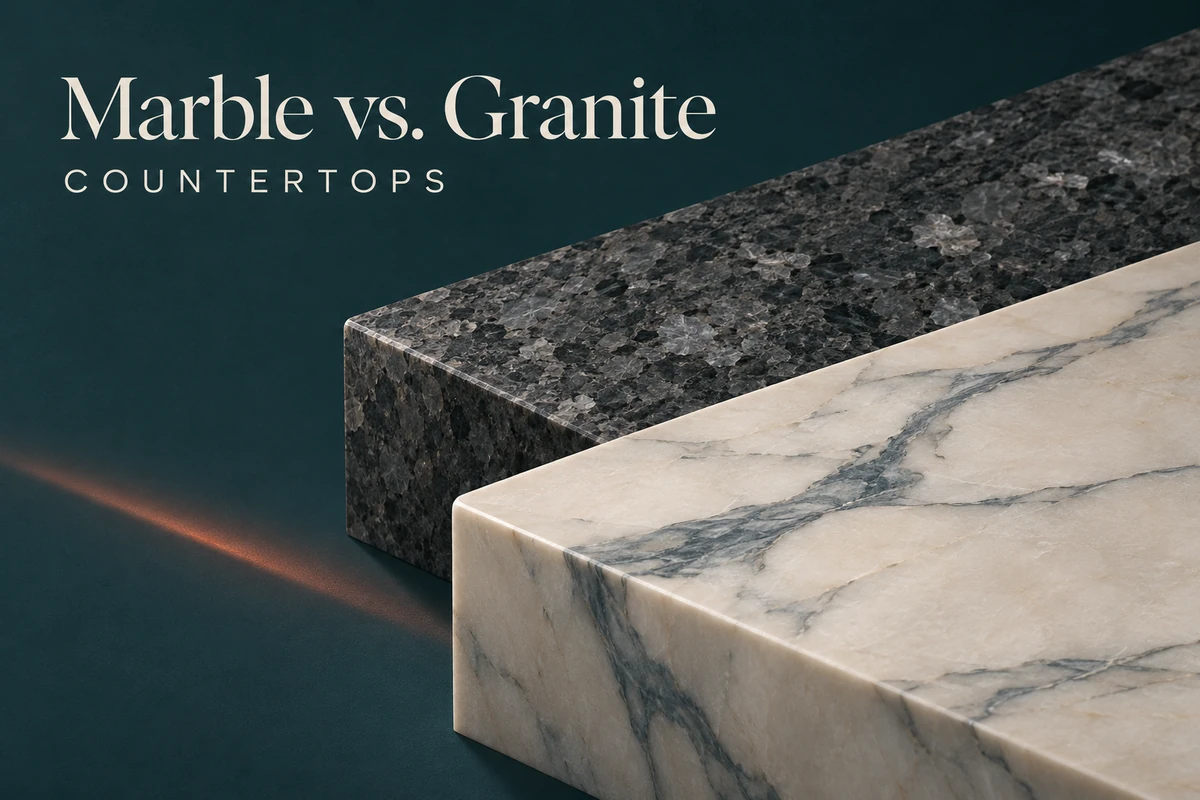
Start with granite for a countertop that takes frequent use and needs to keep its finish with routine care. Choose marble when its veining is central to the design and the owner accepts that acidic spills can leave dull marks. If both stones fit the design, compare samples of the actual slabs and finishes under the conditions the counter will see.
How Marble and Granite Countertops Perform in Daily Use
Granite generally resists scratches and everyday acids better than marble, but how much wear shows also depends on the finish. Decide how much visible wear the owner will accept after opening. The answer may differ between a suite vanity and a busy work counter, even when the same stone looks right in both places.
| Decision factor | Marble countertops | Granite countertops |
|---|---|---|
| Appearance | Often chosen for veining. Review a full slab to see where the strongest veins will land on the finished piece. | Patterns can be fine-grained, speckled, or bold. Review the slab at the scale of the counter, especially if several pieces will sit side by side. |
| Scratches | Typically scratches more easily. Decide how much visible wear the owner will accept on the selected finish. | Generally more scratch-resistant. Protect exposed edges where luggage or equipment can strike the counter. |
| Acid etching | Acids can react with carbonate minerals in marble and leave a dull patch. | Usually less sensitive to everyday food acids. Follow the care instructions for the exact stone and finish. |
| Stains and sealing | Absorption varies by slab. A suitable penetrating sealer can slow absorption. | Some granites are dense enough to need little sealing. Check the selected stone instead of assuming a fixed schedule. |
Etching and Staining Are Different Problems
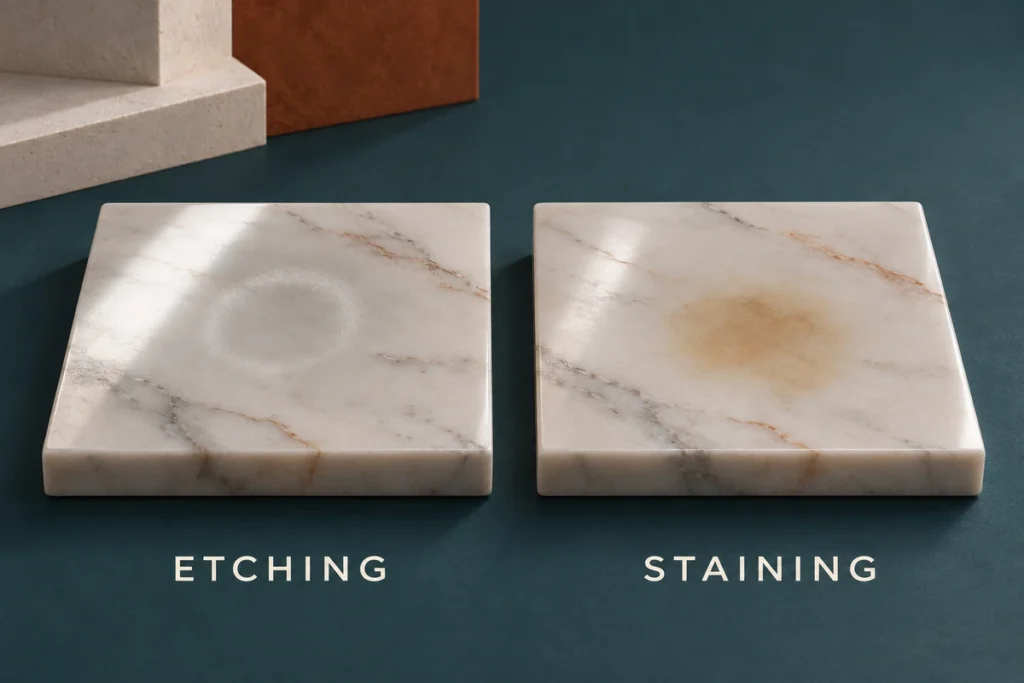
Etching changes the finish itself, while a stain discolors the stone, and the same spill can leave both marks. The Natural Stone Institute describes stone sealers as impregnators that make stone more resistant to staining without making it stain-proof. Sealing gives staff more time to wipe up a spill, but it does not stop acid from reacting with the stone. If housekeeping uses an acidic descaler at the sink and cannot switch products, leave marble off the shortlist for that top.
The Finish Changes How Wear Shows
Use Natural Stone’s selection guide notes that a honed finish often makes etch marks less visible than a polished one. Polished stone also tends to need restoration more often, because etches and scratches stand out on a glossy surface. A honed marble vanity can therefore be a workable choice where polished marble would show every ring. Compare the two stones in the finish you plan to order, not the showroom sample’s finish.
Which Stone Fits Each Hotel Location?
Choose by surface rather than by room, because a vanity top, a reception working top, and a bar top see different spills and impacts.
Guestroom and Suite Vanities
For repeated guestroom vanities, start with granite when housekeeping needs a simple care routine and the finish should change as little as possible. Marble can work for a suite vanity where the veining sets the look and the operator accepts how it will age. Before approving either stone, test it the way the room will use it:
- Apply the proposed bathroom cleaner to a spare piece in the selected finish, following the supplier’s instructions.
- Look across the sample at an angle under lighting similar to the room’s. A patch that blends in under diffuse showroom lighting can be visible from the bathroom door.
- Have housekeeping and the designer review the result together and record the approved cleaner with the care instructions.
Reception Counters
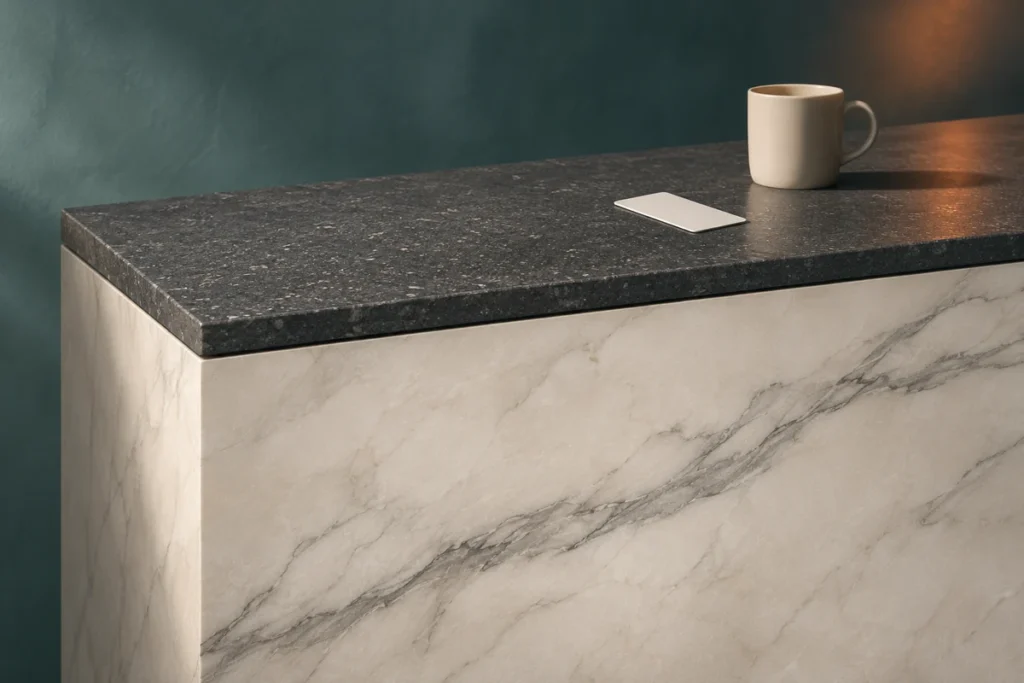
At reception, compare the working top separately from the decorative front. Keys, bags, and cups land on the working surface throughout the day, so start with granite there. If the design calls for a continuous marble vein across the face of the desk, put the marble on the vertical front. Review both finishes together at the line where the front meets the top.
Bars and Restaurant Tables
Citrus, vinegar, and many drinks are acidic, so marble on a bar or dining surface will etch where those spills land. Start with granite for the bar’s working top and for tables that take heavy daily service. Where the concept depends on marble, use it honed on a display ledge or the bar front, away from where drinks are mixed.
What Changes the Cost of a Finished Countertop?
Compare the cost per finished top, because slab yield, quote scope, and upkeep can reverse a difference in slab price.
Slab Yield and Vein Matching
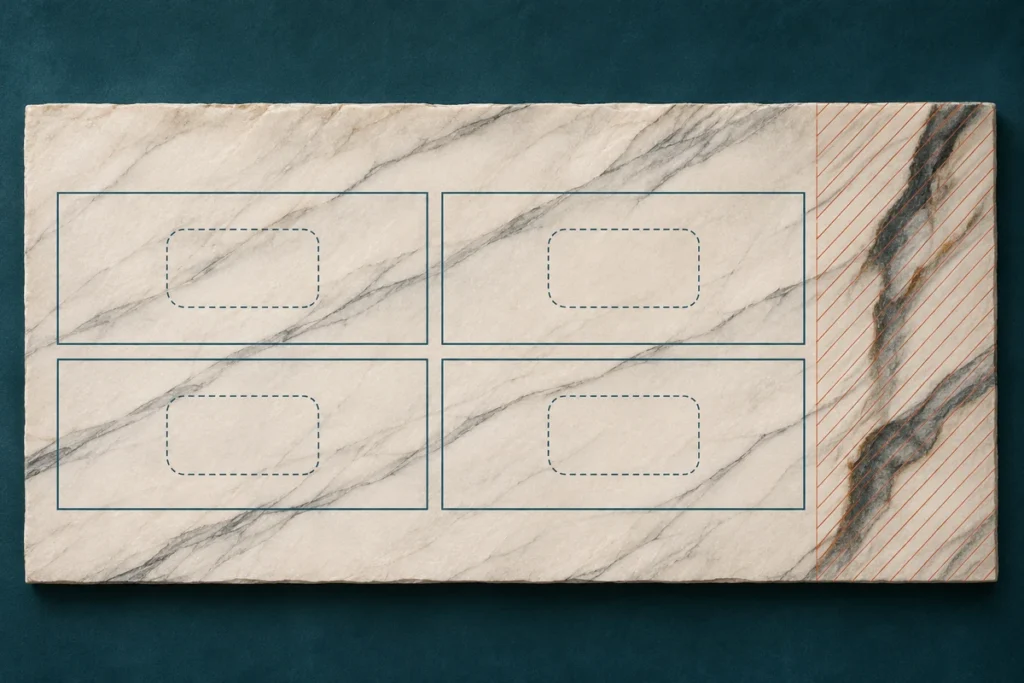
The cheaper slab can cost more per top if the layout needs extra stone. That happens when the veins must run in one direction or the cuts must avoid an area the designer has rejected. Ask the fabricator to show how many usable pieces fit on each proposed slab, especially if the same vanity repeats across several floors.
Comparable Quotes and Upkeep
A quotation comparison is only fair when both fabricators price the same work. Check that both quotes cover:
- The same fabrication scope: Dimensions, quantity, edge profile, sink openings, finish, and delivery destination
- The same delivery terms: Packing, delivery, and installation, so an export supply quote is not compared directly with a local installed price
- Spare tops: Priced separately if the owner wants replacements cut from the selected slabs
- Upkeep: An operator estimate based on each stone’s care instructions, with any occasional professional refinishing priced apart from routine cleaning
From Slab Approval to Countertop Production
Approve the slabs first, then prove the details on one finished top before the rest are cut.
Approve the Slab Range and Layout
Agree on the range of color and pattern the project can accept before the first piece is cut. Use the sample to settle the finish, then review the slab layout with the fabricator. Mark where prominent veins and seams fall relative to each sink opening. If two counters share a sightline, identify them on the schedule so the fabricator can plan the cuts together. Also agree which changes in shade or pattern would need a new approval if the original slabs run short.
Check a First Top Before Repeating It
Use a first fabricated top to check the edge, sink opening, and fit with the vanity cabinet. For a repeated hotel room, an optional full-size mock-up shows the top, basin, faucet, and backsplash together before the remaining units go into production. The site team still verifies field dimensions, cabinet support, and installation conditions before the drawings are released for fabrication.
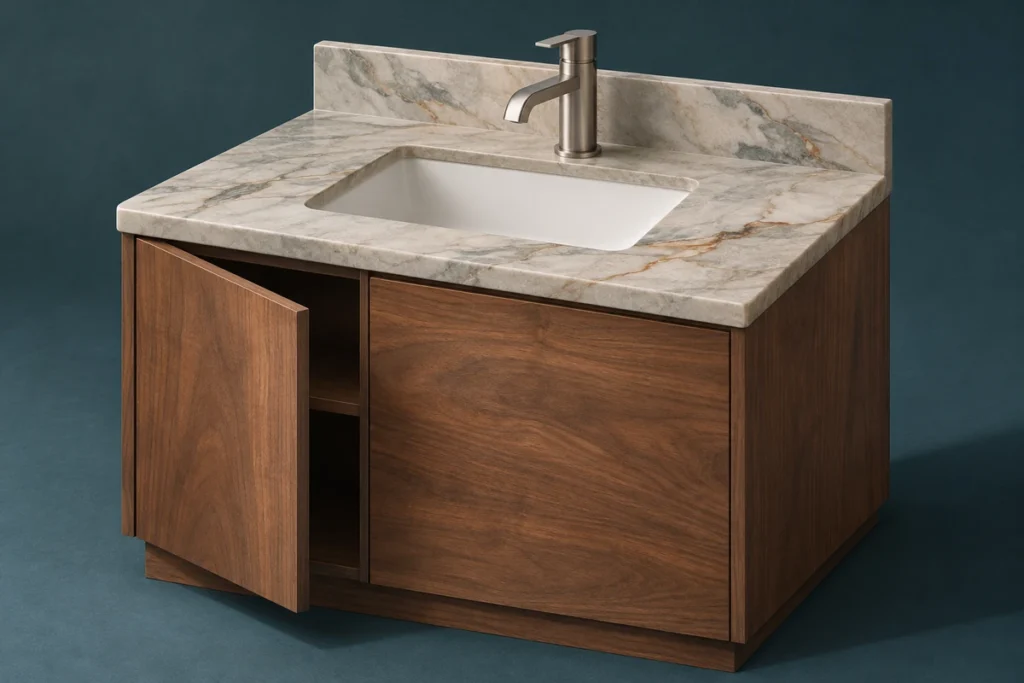
Stone Tops and Vanity Cabinets in One Package
A stone top only works if it sits correctly on the cabinet below it. We make the vanity cabinets as part of OKBuild’s core manufacturing base. The stone tops that sit on them are sourced for the same rooms and checked under our project QC. We review the slab layout, fabrication drawings, and cabinet drawings with your team before cutting. Before packing, finished dimensions, edges, cutouts, and visible workmanship are checked against the approved specification. For a repeat-room order, we can agree room or unit labels and plan export packing to protect finished edges and corners.
To compare both stones fairly, they need one fabrication scope. Share your drawings or bill of quantities in a countertop quote request. Include the top locations, quantities by room type, delivery destination, and any finish samples under consideration. We can then price marble and granite against the same scope while the selection can still change.
FAQ
Can You Identify Marble and Granite by Appearance?
Not reliably, because pattern shows the look but not the mineral content. Ask the supplier to identify the stone in writing and provide an offcut. A stone specialist can run the glass-scratch and acid tests described by Use Natural Stone on that offcut before specifying it.
Can Etched Marble Countertops Be Refinished?
Usually, yes. A stone restoration specialist diagnoses the finish and the depth of damage, then rehones or repolishes the surface. Restoration can take several days and several steps, so schedule it around room availability.
What If Neither Marble nor Granite Fits the Brief?
Compare quartzite, engineered quartz, or porcelain slabs, starting with our quartzite vs. quartz guide. Check destination rules before choosing engineered stone: Australia has banned importing engineered stone benchtops, panels, and slabs since January 1, 2025, while natural stone such as granite is not covered.
Sources
- A Scientific Guide to Shopping for Natural Stone, Use Natural Stone: scratch, acid, and porosity tests on stone samples, sealing that does not prevent etching, and honed finishes that make etch marks less visible.
- Learn About Cleaning Products for Natural Stone, Natural Stone Institute: acid sensitivity of calcareous stone, sealers as impregnators that resist but do not prevent staining, and the difference between stains and etch marks.
- What to Expect During a Natural Stone Restoration, Use Natural Stone: professional diagnosis, rehoning or repolishing, restoration duration, and why polished surfaces need restoration more often than honed ones.
- Engineered Stone Prohibition, Asbestos and Silica Safety and Eradication Agency: Australia’s import ban on engineered stone benchtops, panels, and slabs from January 1, 2025, and the exclusion of natural stone.