


Specify hotel window treatments by room, opening, system, material, operation, performance, and approval status before ordering. A room name, fabric photo, or note such as “blackout curtains” cannot control pricing, fabrication, installation, or inspection.
Keep the room matrix, schedule, drawings, samples, performance evidence, mockup comments, and production release in one controlled package. This connects the work to the wider commercial fit-out package without blurring trade scopes.
How Should Hotel Window Treatments Be Organized by Room and Opening?
Give every distinct opening and treatment configuration a unique mark. Repeat a guestroom standard only after the team confirms that the openings, mounting conditions, controls, and surrounding construction match.
Room Types, Window IDs, and Quantities
Build the schedule from the approved room matrix, including standard rooms, accessible rooms, connecting rooms, suites, and treated public areas.
One row should represent one opening. This keeps the location, configuration, and quantity traceable when room types repeat.
| Schedule field | Record |
|---|---|
| Location | Building, floor, room number, and room type |
| Opening | Elevation, opening location, and opening ID |
| Treatment | Window treatment mark, layers, and control type |
| Quantity | Installed units |
| Reserve | Spare panels, replacement hardware, and mockup material |
Create a new mark when the opening, fabric, fullness, track layout, stacking direction, control, or mounting condition changes. Do not apply one typical-room record to corner rooms, mirrored layouts, bulkheads, columns, or renovation variations.
If one opening has a sheer and a blackout layer, link both systems to the same opening ID. The window treatment schedule and the hotel FF&E schedule should use the same room codes when the contract places window treatments in the FF&E package.
System Configurations and Responsibility Boundaries
Define each layer’s operation, opening direction, stack, overlap, and control. A hotel opening may combine decorative panels, sheers, blackout drapery, roller shades, or dual roller shades.
Scope gaps often occur where the treatment meets controls, building work, or site labor. Assign each interface to a named supplier or trade.
| Interface | Assign in writing |
|---|---|
| Treatment system | Fabric, lining, tracks, rollers, brackets, carriers, stops, and exposed hardware |
| Controls | Motors, power supplies, wiring, programming, and commissioning |
| Building work | Pockets, fascias, backing, anchors, access panels, and perimeter finishes |
| Site work | Field measurement, installation, adjustment, protection, and final acceptance |
Put each exclusion beside the related scope. If one supplier provides the track and another trade provides backing or power, the drawings must show the interface.
Keep the building window and interior treatment as separate systems. The responsible design professional should control glazing, frames, safety conditions, condensation, perimeter details, and code requirements. The fixed glass window specification can supply opening data, but it does not replace the treatment schedule.
Hotel window treatment room schedule](https://okbuilds.com/wp-content/uploads/2026/08/02-scene-window-treatment-room-schedule-1024x683.jpg)
What Must the Window Treatment Specification Record?
The specification must define the proposed assembly, its fit within the opening, its operation, and the evidence required for approval. Replace terms such as “premium,” “hotel grade,” and “full blackout” with measurable requirements.
Dimensions, Mounting, and Clearance Conditions
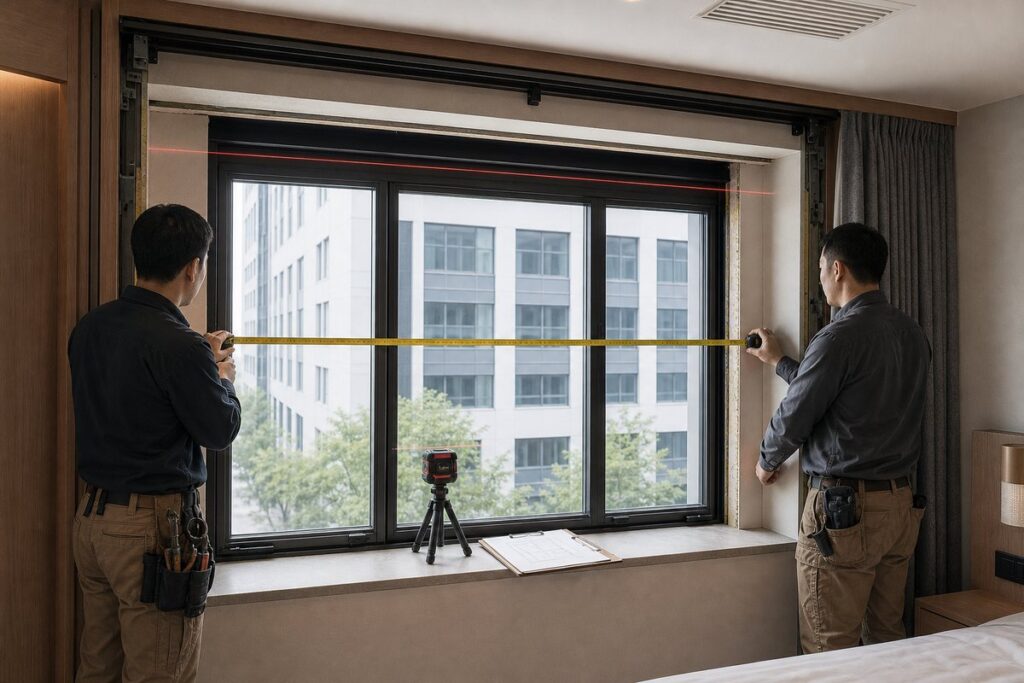
Use field-verified dimensions where fabrication depends on existing construction. Because each measurement controls a different interface, keep these values separate:
- rough opening and finished opening
- finished floor level and ceiling or pocket elevation
- recess depth, wall returns, sill projection, and frame projection
- track or roller width, fabric width, finished drop, stack space, and overlaps
- mounting points, bracket spacing, and access clearances
Show the mounting location and support. Identify the substrate, backing, anchors, and party responsible for load verification. Approve the detail only after the proposed fixings and substrate are known.
Check handles, vents, sprinklers, diffusers, convectors, furniture, and housekeeping routes for interference. Motorized systems also need access to power and controls. During renovation, survey each opening after demolition exposes the substrate and pocket.
Materials, Finishes, and Fabrication Details
Identify each fabric by source, code, color, composition, usable width, weight, face direction, and approved sample. Because the fabric code does not control fabrication, the shop record must also fix:
- lining, interlining, backing, and coating
- heading, fullness, returns, center overlaps, and stack direction
- seam locations, side hems, bottom hems, weights, and finished drop
- pattern repeat, pattern matching, grain or face direction, and panel orientation
- track, roller, carrier, bracket, fastener, stop, connector, and exposed finish
Natural fibers, coated fabrics, printed patterns, and textured fabrics may show production variation. Define the acceptable range with a control sample. Where adjacent panels must match, approve the batch and keep its reference for replacements.
The hotel soft furnishing package should still be priced by opening, fabric layer, hardware set, control type, and room quantity. A single fabric rate does not describe the finished treatment.
Operating and Maintenance Requirements
Operation changes the hardware, controls, and maintenance access. For each system, define how guests and staff will use it and how the hotel can service it:
- manual draw, wand, chain, crank, switch, remote, or control-system interface
- control location, travel direction, stopping position, and group behavior
- override method, limit setting, programming, and commissioning responsibility
- access for adjustment, cleaning, removal, and component replacement
Check control locations, entanglement risks, noise, travel speed, and housekeeping access against destination rules and project requirements. For motorized systems, confirm that the motor, track or tube, fabric, controls, and expected duty work together.
Approve cleaning instructions before ordering. Record permitted chemicals, temperature limits, stain treatment, removal, and replacement procedures. Use permanent labels so off-site cleaners can return each panel to the correct opening and hanging direction.
Performance and Compliance Requirements
When performance affects acceptance, name the requirement, test method, classification, jurisdiction, and approval authority. Apply light-control, textile, accessibility, electrical, cord-safety, acoustic, or emissions criteria only when the project requires them.
A certificate is useful only when its scope matches the offered product and construction.
| Evidence field | Approval question |
|---|---|
| Product identity | Do the manufacturer and product code match the offer? |
| Tested construction | Does the report cover the proposed fabric, lining, coating, adhesive, hardware, motor, or assembly? |
| Test record | Are the method, result, issuing body, and report date stated? |
| Limits | Do the specimen size, installation condition, and exclusions cover the proposed use? |
A generic certificate does not establish compliance. A report for an unlined fabric may not cover the same fabric after the supplier adds a backing, coating, adhesive, or different fabrication.
Define how the mockup will assess room darkening or blackout. Check light at the head, sill, sides, center overlap, and hardware penetrations. Do not promise complete darkness unless the approved assembly and room conditions can support that result.
What Should the Supplier Submittal Include?
For an OKBuild window-treatment package, our submittal identifies the offered system, discloses every departure from the specification, and links each approval item to its supporting documents.
Compliance Matrix, Exceptions, and Proposed Substitutions
Require a line-by-line compliance matrix. Each response should give its status and supporting document. Treat blank responses as unresolved.
Keep exclusions, qualifications, and assumptions in one register. Before approving an exception, record its effect on:
- dimensions and surrounding interfaces
- appearance, operation, performance, and maintenance
- price, production sequence, and delivery
- drawings, samples, testing, and warranty terms
Keep proposed substitutions separate from the specified base offer until the approval authority accepts them in writing. Compare the complete assembly, not just the fabric or hardware name.
When an order includes several commercial project product categories, trace each window treatment exception to its opening IDs. A package-level approval should not hide an unresolved fabric, control, or installation issue.
Drawings, Product Data, and Test Evidence
Shop drawings should resolve the interfaces that control fabrication and installation. Keep only the information the team needs to approve the proposed assembly:
- opening IDs, quantities, field dimensions, and finished dimensions
- plans, elevations, sections, and adjacent construction
- track or roller layout, stacking, overlaps, returns, pockets, and fascias
- brackets, anchors, seams, controls, power points, and access panels
- revision, date, submission status, and document owner
Product data should identify the proposed assembly and accessories. Include installation, operation, cleaning, and maintenance instructions. Add calculations or manufacturer selection records when weight, width, span, or motor capacity controls selection.
Submit test evidence only when it can be traced to the proposed material or assembly. Mark the covered model, construction, result, and limitation. The responsible project professional should review each document within the scope assigned by the contract.
Fabric, Finish, and Hardware Samples
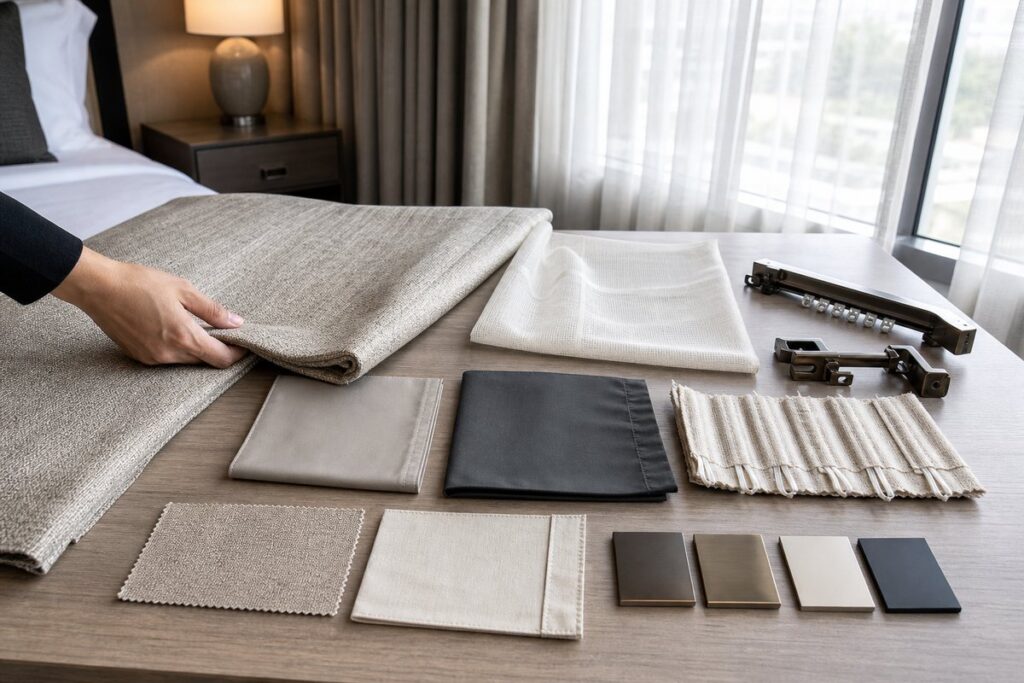
Physical samples should show the proposed color, texture, weave, opacity, coating, backing, seam, heading, and hardware finish. Use a larger sample or full-width drop to review pattern scale, drape, pleats, and transmitted light.
Label each sample with its project, item, room, supplier, product, color, submission, date, and status. Add the batch when known. For an OKBuild order, we keep matching control samples with the project team.
State exactly what each sample approval covers. Approval of the face fabric does not approve the lining, fabrication, hardware, or completed assembly.
How Should the Team Review Mockups and Close Approval?
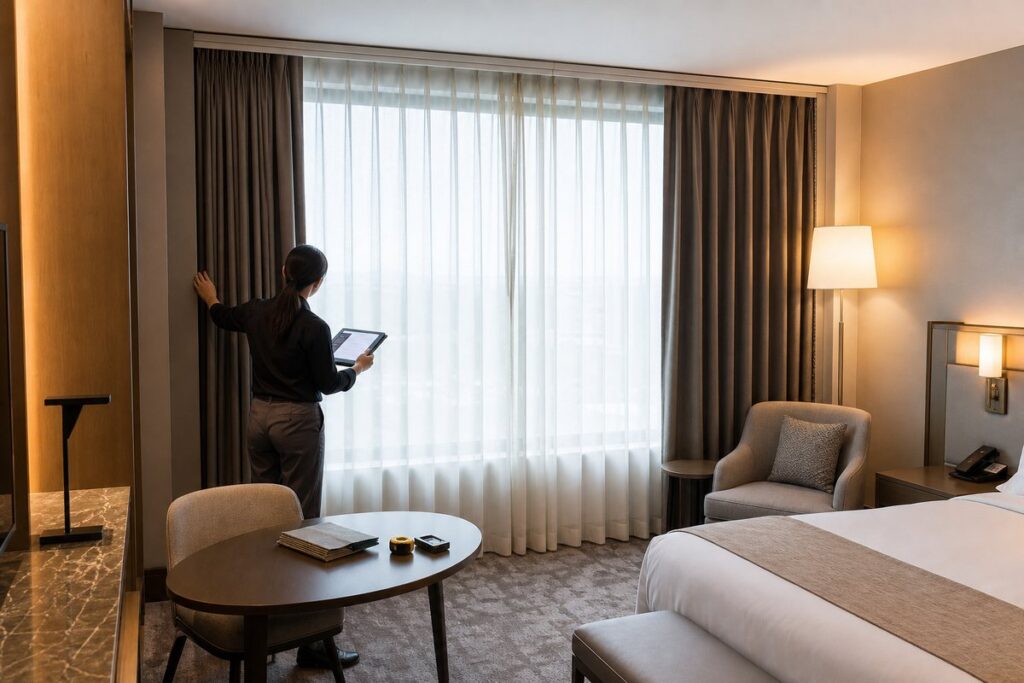
For repeated room types, review a representative installation before releasing batch production. The mockup must use the intended opening, approved materials, proposed hardware, and planned controls.
Review Roles, Document Status, and Version Control
Split approvals by responsibility so design comments do not become code, operational, or commercial approvals. Assign a reviewer for:
- design intent and visible appearance
- room operation, housekeeping, and maintenance
- code, accessibility, and electrical interfaces
- commercial changes and final production release
The owner should name one accountable lead to collect comments and issue a coordinated response. Use clear statuses such as submitted, under review, revise and resubmit, approved with comments, and approved for production.
Each status must identify the drawing, sample, test document, mockup record, and revision it covers. If a fabric or hardware change affects several openings, update the schedule, drawings, sample record, quotation, and order release together.
Mockup Checks for Light Gaps, Privacy, Operation, and Appearance
Review the mockup under the lighting conditions that matter to the room. Record the room, time, control position, observations, and photographs.
| Review area | What to check |
|---|---|
| Light and privacy | Head, sill, sides, center overlap, corners, hardware penetrations, and relevant viewing angles |
| Operation | Pull force or control response, noise, speed, alignment, stopping positions, tracking, stack width, motor limits, and access |
| Interference | Handles, furniture, ceilings, pockets, access panels, and air outlets |
| Appearance | Finished drop, hem line, fullness, pleats, seams, pattern direction, returns, wrinkles, exposed hardware, and adjacent alignment |
When the order involves hotel material sourcing from China, keep the approved mockup as a production reference.
Revision Closeout and Order Release
Turn each mockup comment into a numbered action with an owner, due date, opening IDs, and required proof. Close it with a revised document, sample, photograph, test record, or witnessed recheck.
Release the order only when the quantity, technical, commercial, and approval records point to the same revision. Before release, align:
- final room, opening, installed, and spare quantities
- approved drawings, samples, performance evidence, and mockup records
- fabric, finish, hardware, motor, and control references
- price, packing, labels, delivery lots, installation, and warranty documents
- approvals that release material purchasing and fabrication
The purchase order should cite the approved package and change procedure. Place nonblocking unresolved items on documented hold. Do not release production from an unmarked email, verbal approval, or superseded revision.
Frequently Asked Questions
What Factors Affect the Cost of Hotel Window Treatments?
Cost depends on opening size, quantity, treatment layers, fabric width and repeat, fullness, lining, fabrication, hardware, controls, installation, testing, mockups, packing, spares, and delivery scope. Compare quotations against the same opening schedule and approved configuration because a lower fabric rate may require more seams, waste, hardware, or installation work.
How Far in Advance Should Custom Hotel Window Treatments Be Ordered?
Set the order date by working backward from installation. Allow time for field measurement, drawings, samples, performance review, mockup work, revisions, material reservation, production, inspection, packing, shipping, site access, and installation. No single lead time applies to every project. Obtain a milestone schedule for the approved system, quantity, and destination, then revise it when approvals or site dates change.
Can Existing Tracks or Pockets Be Reused During a Hotel Renovation?
Existing tracks or pockets may be reused if a site survey confirms their dimensions, condition, capacity, fixings, clearances, compatibility, operation, and repair access. Inspect representative conditions after removing the old treatments because concealed anchors, worn carriers, bent sections, obsolete parts, or undersized pockets may affect the new assembly.
What Warranty Information Should Buyers Request Before Ordering?
Request written terms for the fabric, coating, fabrication, track or roller, motor, controls, power components, and installation where applicable. Confirm the warrantor, covered defects, start date, duration, exclusions, operating limits, maintenance duties, claim process, labor, removal, reinstallation, freight, and replacement-part responsibility. One component warranty may leave the buyer responsible for the rest of the installed system.
How Should Hotels Plan Spare Panels and Replacement Fabric?
Set spare quantities by room repetition, damage exposure, cleaning cycle, replacement difficulty, batch variation, and expected product availability. Record spare panels, fabric rolls, and service hardware separately from installed quantities. Store each item with its opening IDs, product code, color, batch, direction, usable width, and care instructions. Confirm storage conditions and shelf-life limits before ordering.